01Are Free A/B Testing Tools Actually Free?
Every tool in this roundup has a genuine free tier — not a 14-day trial that locks you out. But “free” means trade-offs: traffic caps, limited features, no dedicated support, and self-service setup. The question isn’t whether these tools cost money. It’s whether the limitations cost you more in missed insights and bad decisions.
The table below compares all five free tools at a glance. Each one is covered in detail in its own section below. The first row is Apex by DRIP, our own paid platform, included so you can see what the free tiers do not do rather than to sell you out of them.
| Tool | Type | Free Tier Limit | Best Feature | Catch |
|---|---|---|---|---|
| Apex by DRIP (not free) | Paid platform with managed execution | No free tier, book a call | Scores test ideas before launch against 4.3 million past A/B tests | Not free, and the price is not published |
| VWO Free | Commercial SaaS | 50K users/month (verify current availability) | Full Bayesian A/B testing | Limited to 3 active tests |
| PostHog | Open-source | 1M events/month | Analytics + experimentation | Self-hosted or cloud limits |
| GrowthBook | Open-source | Unlimited (self-hosted) | Feature flags + testing | Requires developer setup |
| Statsig | Commercial SaaS | Free tier | Enterprise-grade stats | Complex setup, data-heavy |
| Google Analytics 4 | Google product | Unlimited | Already installed everywhere | Very limited testing capability |
One important distinction: “free tier” and “open-source” are not the same thing. VWO and Statsig offer free tiers of commercial products — the company controls the roadmap and can change terms. PostHog and GrowthBook are open-source — you can self-host them and own the infrastructure entirely. That difference matters for long-term planning.
02Before You Pick a Free Tool, When Does Free Get Expensive?
Apex by DRIP is our A/B testing platform for online shops. It is first on this page for one honest reason: the biggest cost in a testing program is usually not the license. It has three layers.
- Test memory: 4.3 million A/B tests from 151,000 shops, collected over eight years. It is one of the largest A/B test databases in e-commerce, and it scores every test idea before launch, so the backlog is ranked by evidence instead of enthusiasm.
- Testing tool: build, launch, and evaluate A/B tests directly in the shop. Prediction and execution live in the same place, so every prediction gets checked against the result.
- Managed execution: tests are built, QA’d, launched, and analyzed with the DRIP team. This is the layer no free tier includes, and it is why Apex pricing is set in a call.
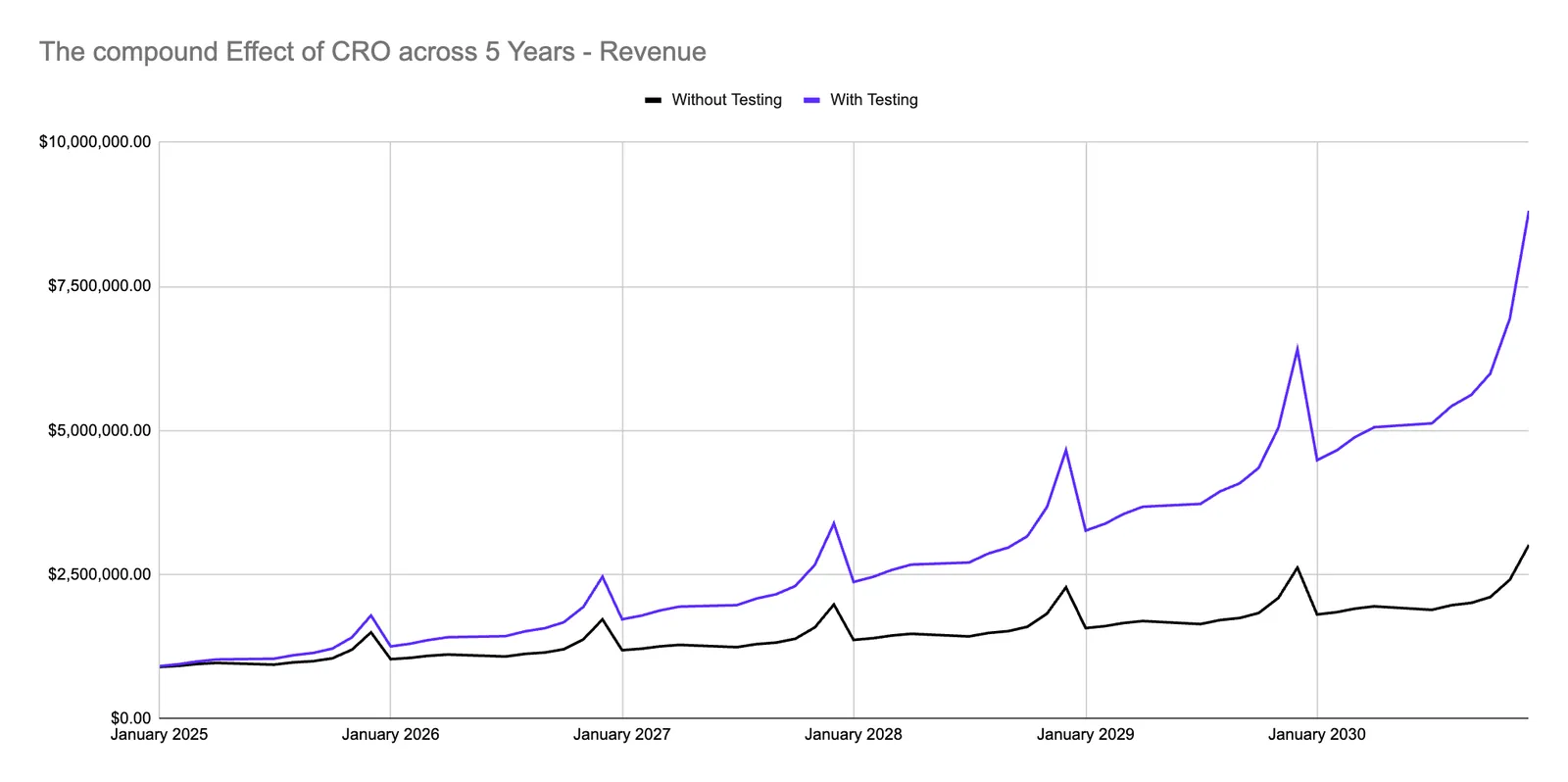
Here is when free gets expensive. A test costs a license fee and it costs a slot: the weeks of traffic it occupies, plus the work to design it, build it, QA it, and read it. Industry-wide, about 1 in 5 tests produces a confirmed win, so four of every five slots end with nothing to ship. That is the real bill, and it is identical whether the tool cost you nothing or a lot. Across more than 4,000 experiments for 50+ brands, our own win rate moved from 27% in 2024 to 55% in the most recent quarter, and almost all of that came from ideas we rejected before anyone built them. Selecting better ideas is the only lever that reduces the number of wasted slots, and no free tier has that data.
Now the honest limits, because this is a page about free tools. Apex is not free, there is no free tier, and there is no published price, so it cannot compete on the thing you came here for. If your budget is zero, if you are still proving that testing works at all, or if you want to sign up and ship a test this afternoon, Apex is the wrong choice and one of the tools below is the right one. Every recommendation on this page stands: VWO Free is still the best starting point for most teams, PostHog and GrowthBook are still the best open-source options for developer-led teams, GrowthBook still wins for warehouse-native data teams, and Statsig still offers the deepest statistics on a free tier. A prediction is also a prior, not a guarantee, and our win rate is our own program’s record rather than a forecast for a single shop. The honest sequence is to start free, prove the methodology, and look at prediction when your constraint stops being budget and starts being how few test slots you have.
Want Apex to score your test ideas before you build them? See if your shop is a fit→
03VWO Free — Best Free A/B Testing Tool Overall
VWO’s free plan is the closest thing to a real A/B testing platform at zero cost. You get the same Bayesian SmartStats engine that powers their enterprise plans, a visual editor for creating variants without code, and basic targeting options. No credit card required, no time limit — though note that VWO’s free tier terms may have changed, so check their current pricing page for the latest availability.
What You Get for Free
- A/B testing with a drag-and-drop visual editor
- Bayesian SmartStats — no need to manually calculate sample sizes
- Up to 50K monthly tracked users
- Basic audience targeting by URL, device, and geography
- Mobile-responsive testing across device types
- Standard reports and dashboards with confidence intervals
What’s Missing
- Limited to 3 concurrent tests — you cannot run more simultaneously
- No multivariate testing (MVT) — A/B only
- Server-side testing and feature flags are available through VWO FME (FullStack), but not included in the free plan
- No heatmaps or session recordings (those require VWO Insights, a paid add-on)
- No advanced segmentation or behavioral targeting
- Community support only — no SLAs or dedicated account manager
Who Should Use VWO Free
E-commerce brands with under 50K monthly users who want to start testing without any financial investment. Marketing teams that need a visual editor and cannot write code for variant creation. Startups validating CRO as a growth channel before committing budget. Solo operators or small teams that want real statistics without the complexity of open-source setup.
04PostHog — Best Open-Source Analytics + Testing
PostHog combines product analytics, session recordings, feature flags, and A/B testing in one open-source platform. If you’re already using PostHog for analytics, adding experimentation is a no-brainer — the data is already there, and the testing infrastructure integrates directly with your existing event tracking.
What You Get for Free
- A/B testing and multivariate testing with statistical analysis
- Feature flags with percentage rollouts and targeting rules
- 1M events per month on cloud (self-hosted is free but has a practical limit of around 100K users/month depending on your infrastructure)
- Product analytics with trends, funnels, paths, and retention
- Session recordings — 5K per month on the cloud free tier
- Funnels, user paths, and retention analysis built in
What’s Missing
- No visual editor — all variants must be implemented in code
- Statistical engine is simpler than VWO’s Bayesian SmartStats or GrowthBook’s CUPED
- Self-hosting requires DevOps resources and infrastructure management
- Cloud free tier (1M events) may be insufficient for larger e-commerce sites
- E-commerce-specific integrations are limited compared to dedicated CRO tools
- No dedicated CRO features like form analytics or advanced heatmaps
Who Should Use PostHog
Developer-heavy teams already using PostHog for product analytics. Startups that want one unified tool for analytics, feature flags, and experimentation. Teams comfortable with code-based variant creation who do not need a visual editor. Companies that value open-source transparency and want the option to self-host their data.
05GrowthBook — Best Open-Source Feature Flag + Testing Platform
GrowthBook is built specifically for feature flags and A/B testing, with a strong statistical engine that uses sequential testing and CUPED for faster results. Fully open-source and self-hostable, it gives data-savvy teams the most powerful free testing engine available.
What You Get for Free
- Unlimited feature flags on self-hosted deployments
- A/B testing with both frequentist and Bayesian statistical engines
- CUPED variance reduction — reach statistical significance with less traffic
- SDK support for 15+ languages including JavaScript, React, Python, Go, and Ruby
- Visual editor (cloud only) for non-code variant creation
- Integrations with Segment, Rudderstack, and warehouse-native data sources like BigQuery and Snowflake
What’s Missing
- Self-hosting requires infrastructure management and DevOps knowledge
- Visual editor is cloud-only — not available for self-hosted deployments
- No built-in analytics — relies entirely on your data warehouse for metric definitions
- Smaller community than PostHog, fewer community-contributed integrations
- Cloud free tier is limited in users and features
- UI is functional but not as polished as commercial platforms like VWO
Who Should Use GrowthBook
Engineering teams that want full control over their experimentation infrastructure. Companies with existing data warehouses who want experiment analysis in the same environment. Teams prioritizing feature flags alongside A/B testing. Organizations that need CUPED variance reduction to reach significance faster with limited traffic.
06Statsig — Best Free Enterprise-Grade Statistics
Statsig brings enterprise-grade statistical rigor to a free tier. Founded by ex-Facebook engineers, it implements the same sequential testing methodology used at Meta scale. The free tier is generous for small teams — feature gates, dynamic configs, A/B testing, and auto-tune capabilities at no cost.
What You Get for Free
- Feature gates and dynamic configs for controlled rollouts
- A/B testing with sequential analysis — stop tests early without inflating false positive rates
- CUPED for variance reduction and faster time-to-significance
- Autotune (multi-armed bandits) for automatic traffic allocation to winning variants
- Basic analytics dashboards with real-time experiment monitoring
- Up to 2M events per month on the free tier
What’s Missing
- Complex setup — steeper learning curve than VWO or PostHog
- Visual editor is available but less mature than VWO’s — most teams still use code-based implementation
- Free tier event limits (2M) can be hit quickly on high-traffic e-commerce sites
- Primarily designed for product teams, not CRO or marketing teams
- E-commerce-specific features like checkout optimization are limited
- Data residency options are limited on the free tier
Who Should Use Statsig
Product teams with engineering resources and a background in experimentation methodology. Companies that need advanced statistics like sequential testing and false discovery rate control across many concurrent experiments. Teams running high-velocity experimentation programs where statistical rigor is non-negotiable.
07Google Analytics 4 — Free But Very Limited
GA4 has basic A/B testing capabilities through its built-in experiment framework and Firebase integration for mobile apps. But calling it an “A/B testing tool” is generous — it’s an analytics platform with some testing features bolted on. Google shut down Optimize in 2023 and has not launched a replacement, which tells you where testing sits in Google’s priority list.
What You Get
- Native integration with your existing GA4 setup — no additional scripts
- Basic redirect tests through audience-based experiments
- Audience-based experiments using GA4 audience definitions
- Firebase A/B testing for mobile apps with remote config
- Free and already installed on the vast majority of websites
Why We Don’t Recommend It for Serious Testing
- No visual editor for creating client-side variants
- Statistical methodology is basic — no sequential testing, no CUPED, no Bayesian options
- Very limited targeting options compared to any dedicated testing tool
- No multivariate testing capability
- Reporting is minimal — no confidence intervals, no segment breakdowns, no revenue attribution
- Google Optimize was shut down in September 2023 — testing is clearly not a priority for Google’s analytics roadmap
The one scenario where GA4 testing makes sense: mobile apps using Firebase. The Firebase A/B testing integration with remote config is a genuinely useful tool for testing app-side changes. For web-based e-commerce testing, look elsewhere.
08When to Upgrade from Free to Paid
Free tools are a genuine starting point, not a trap. But recognize the signals that it’s time to invest. Staying on a free tier past the point of diminishing returns can slow your testing program more than the tool’s price would. An A/B testing agency can help you determine whether the real constraint is the tool or the testing process.
Upgrade Signals
- You’re consistently hitting traffic limits (50K users on VWO Free, 1M events on PostHog cloud, 2M events on Statsig)
- You need more than 3 concurrent tests to maintain your testing velocity
- Your tests require server-side rendering or multivariate capabilities
- You need advanced targeting — geography, behavioral segments, or custom audiences
- Your team needs dedicated support, SLAs, and onboarding assistance
- You’ve proven ROI from testing and the business is ready to invest in scaling the program
The ROI Math
If a single winning A/B test improves conversion rate by 0.5% on a store doing €1M per month in revenue, that’s €60K per year in additional revenue. Even a $500/month testing tool pays for itself many times over from one successful test. The question is never “can we afford a paid tool?” — it’s “can we afford not to have one?”
09Our Recommendation
Best Free Tool for Most Teams
VWO Free. Real Bayesian statistics, a drag-and-drop visual editor, and up to 50K users per month (verify current free tier availability on VWO’s pricing page). The learning curve is gentle, the statistical engine is reliable, and the upgrade path to paid plans is smooth when you outgrow the free tier. For Shopify teams, a Shopify CRO agency can also validate whether that upgrade path fits the store’s app stack and testing velocity.
Best Free Tool for Developers
PostHog if you want analytics and testing in one unified platform. GrowthBook if you want the most statistically rigorous testing engine with CUPED variance reduction and warehouse-native data integration. Both are open-source, both are free to self-host, and both give developers full control over the experimentation stack.
Best Free Tool for Data Teams
GrowthBook’s warehouse-native approach wins. Connect directly to BigQuery, Snowflake, or Redshift and keep all your experiment data alongside your other analytics data. No exports, no ETL pipelines, no data silos. Your analysts use the same SQL environment they already know.
When Free Isn’t Enough
When you outgrow free tiers, ABlyft offers the lightest performance footprint and most developer-friendly architecture for growing e-commerce brands. VWO’s paid plans offer the smoothest upgrade path from their free tier — everything you’ve built carries over, and you simply unlock more features.
When Test Slots, Not Budget, Are the Constraint: Apex by DRIP
We sell Apex by DRIP, so check the reasoning rather than the ranking. If you are already testing on a free tier and the results keep coming back flat or inconclusive, a bigger traffic cap will not fix that. About 1 in 5 tests wins industry-wide, so the scarce resource is the test slot, not the license. Apex scores each idea against 4.3 million A/B tests from 151,000 shops before anyone builds it, and the tests are then built, QA’d, and analyzed with the DRIP team. That is the lever that moved our own win rate from 27% in 2024 to 55% in the most recent quarter. Apex is not free, there is no free tier, and the price is set in a call, so if budget is the binding constraint the free tools above are the better answer and we will tell you so.