01How Do Apex and Visually.io Compare at a Glance?
| Apex by DRIP | Visually.io | |
|---|---|---|
| Built for | Shops whose tests keep coming back flat: the constraint is choosing which tests to run, not building them | “eCommerce entrepreneurs and mature teams ready to take control over their site optimization” |
| Shop systems | Installs as a Shopify app: two-click install via link, server-side tracking, first-party data | Shopify and Shopify Plus; headless Shopify via a Hydrogen reference project and a framework-agnostic guide |
| Can test | Pages and page elements, parallel tests on the same traffic with optional exclusion groups, A/A tests, redirect tests, global holdout, feature flags and staged rollouts | Themes, templates, homepage, product pages, carts, checkouts, post-purchase upsells, discounts, shipping, redirect tests; price tests above order minimums |
| Prediction before launch | Likelihood to Win: one percent figure per test idea, shown with how many tests back it | “AI recommendations” and “Optimization suggestions”; no per-idea prediction found |
| Building tests | Experiment config as code, code editor, visual builder (Operator), CLI preview links, QA via preview, MCP connection | Visual editor, code editor (JavaScript, CSS, HTML), Copilot edits in natural language, Smart Component Generator, preview by link or QR code |
| Statistics and metrics | Fixed-horizon with confidence; main metric, lift, runtime revenue per test; profit per test on Shopify; Guardian auto-stop | Bayesian; significant at “Odds to Win >80%” plus a minimum sample size; conversion rate, AOV, per-session value; profit metrics and auto-stop: none found |
| Heat maps | Heat maps and behaviour per variant: clicks, scroll depth, average fold, funnel steps | Native heat maps: none found; integrations with Clarity, Heatmap.com, FullStory and Contentsquare |
| AI and agents | Apex chat in the app, backlog with auto-classification and score, MCP and CLI | Copilot editor with a choice of models; MCP server for Claude and ChatGPT for reporting questions |
| Data location | Hosting in the EU plus UK; GDPR in place; ISO 27001 and SOC 2 in progress | Hosting region not published; privacy policy: data “will be transferred outside of Europe”; SOC 2 and GDPR programs in progress |
| Entry price | Pricing not published; a card-free free tier for one store; book a call | $19 per month up to 200 monthly orders; 14-day free trial (website, checked October 2026) |
| Reviews | No public review profile yet | 4.8 from 147 reviews on the Shopify App Store (checked October 2026) |
02What Is Each Tool Built For?
Apex by DRIP is an A/B testing platform for companies selling online that predicts which tests will win before they go live, built on one of the largest A/B test databases in e-commerce. We call the method Prediction-Based Experimentation. In plain words: we know what shops like yours tested and which tests won. Apex has three layers: a test memory of 4.3 million A/B tests from 151,000 shops, collected since 2011; a testing tool to build, launch and evaluate tests directly in the shop; and managed execution, where tests are built, checked, launched and read together with the DRIP team.
Visually.io positions itself as a “One-stop, AI powered A/B testing & personalization platform for ecommerce”. Its Shopify App Store listing reads: “AI-powered A/B testing, split testing, and personalization. With Visually AI, test every stage of the shopper journey.” The vendor names its audience as “eCommerce entrepreneurs and mature teams ready to take control over their site optimization”. Next to tests it offers personalisation by segment, product recommendations and upsells in one app.
03What Can You Test With Apex and With Visually?
Visually’s listing says: “Run a split test to max conversion rate on themes, discounts, prices & shipping.” Here Visually can do things Apex does not document. Price, discount, shipping and checkout tests, personalisation and product recommendations are not among Apex’s documented test types. If those are central to your program, that is a reason to look at Visually.
Price tests on Visually come with conditions. The help center states: “We currently support price testing for Shopify Plus stores with 7,500+ orders per month on pro, or those on our Scale plan with at least 600 monthly orders.” The vendor’s team sets these tests up.
| What you want to test | Apex by DRIP | Visually.io |
|---|---|---|
| Pages and page elements | Yes | Yes: homepage, product pages, carts |
| Themes and templates | Page elements; theme tests not documented | Theme tests and template tests |
| Prices and offers | Not documented | Discounts and shipping; prices above order minimums |
| Checkout and post-purchase | Not documented | Checkouts and post-purchase upsells |
| Landing pages and redirects | Redirect tests | Redirect tests with source and destination URL |
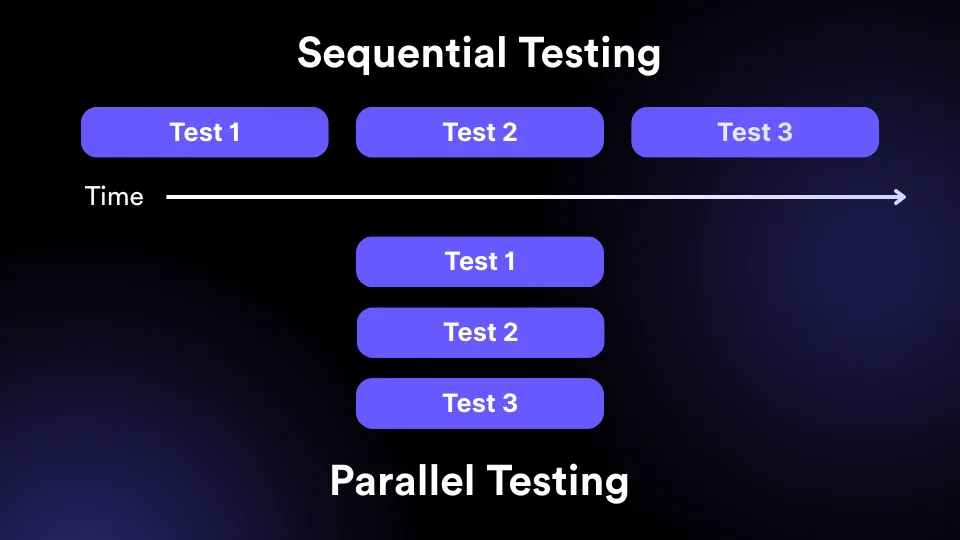
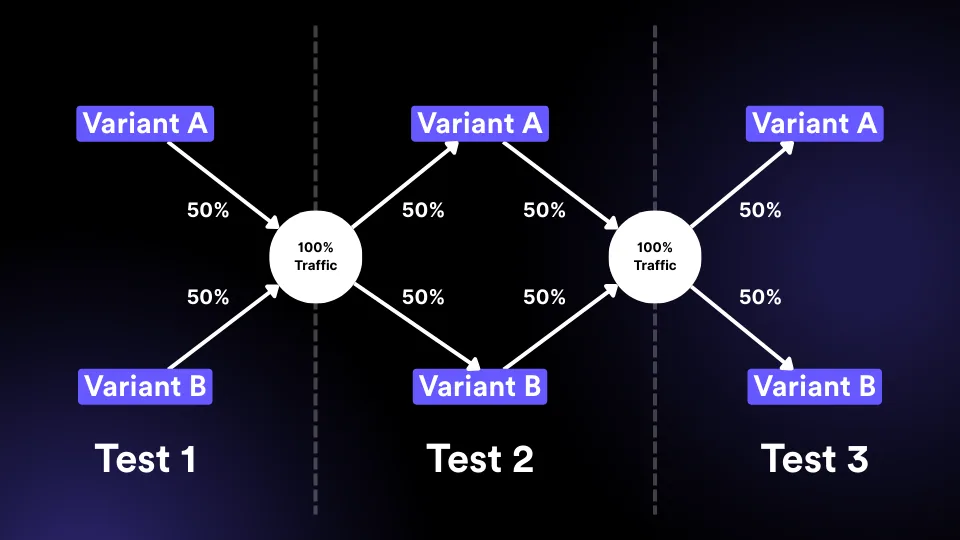
| Parallel tests | Yes, with optional exclusion groups | Recommended by the vendor; exclusion groups not documented |
| Global holdout | Yes | Global Control Group |
| Feature flags and rollouts | Feature flags and staged rollouts | Feature flags listed |
| Personalisation and recommendations | Not documented | Personalisation by segment; product recommendations |
04How Do Tests Get Built and Launched?
In Apex, experiment config lives as code, with a code editor and a visual builder called Operator next to it. CLI preview links and QA via preview let you check a variant before it goes live. The MCP connection lets a shop owner build and read tests from ChatGPT or Claude without a terminal; the CLI is the developer path. Apex shows clients four QA checks: all devices, tracking and targeting, responsive, and matches design. Guardian stops a test automatically at a revenue loss threshold.
Visually offers a “Next-gen visual editor” on all plans and a code editor for global JavaScript, custom CSS and HTML. Its Copilot edits variants in natural language, with a choice of models that is locked per experience. The Smart Component Generator turns “plain English prompts (or images) into components”. Previews go out by email link, copy link or QR code.
On the storefront, Visually describes its method as “Non-Destructive Client-Side Modifications” through “DOM and CSS manipulations”. We found no server-side option in its documentation.
Both vendors offer hands-on help. Visually lists a dedicated CSM from 3,000 monthly orders and a “Fully Managed” option with a CRO plan from 7,500 orders. In Apex’s managed execution, tests are built, checked, launched and read together with the DRIP team.
05How Are Winning Tests Chosen Before Launch?
In Apex, every test idea gets a Likelihood to Win before launch. The Likelihood to Win is one percent figure per test idea, shown with how many tests back it. The backlog classifies ideas automatically and shows the score.
The score is checked in two ways. In a holdout check within a shop, the top third of ideas won 1.4 to 1.6 times as often (press release, September 29, 2026). Predictions for 33 brands were scored and frozen in early September 2026. We publish the first results from November 2026.
This page is part of our comparison of A/B testing tools for online shops. The full shortlist is here.
Visually’s listing names “AI recommendations” and “Optimization suggestions” among its features. We found no documentation of how ideas are prioritised or of a prediction per idea. Its AI features documented in detail are for building: Copilot and the Smart Component Generator create variants from prompts.
06Which Statistics and Metrics Does Each Tool Use?
Apex reads tests fixed-horizon with confidence. Each test shows its main metric, lift and runtime revenue. On Shopify, Apex reports profit per test (“optimise for profit”), using discount share, refund share and profit per sale. Guardian stops a test automatically at a revenue loss threshold.
Visually uses Bayesian models: “Binomial Bayesian” for conversion rate, “Gaussian Bayesian” for AOV and per-session value, and a “Combined Model” for some metrics. A result is marked significant when “Odds to Win >80%” and a minimum sample size “calculated at 80% power” is met, with a 95% confidence interval shown. A Global Control Group holds back a share of traffic from all tests.
We found no profit metrics, auto-stop, sample ratio check or bandit in Visually’s documentation. The vendor tells users to set the winning variant to 100% by hand.
07What Do Apex and Visually Cost?
Visually bills by monthly orders through Shopify on a 30-day cycle, with orders sampled “~every 10 days”. The pricing page offers a 14-day free trial with “No commitment” and “CC not needed”, and no contracts. A free plan exists for development stores. These are the website prices, checked October 2026:
| Monthly orders | Price per month | What is added |
|---|---|---|
| Up to 200 | $19 | Visual editor, personalisation, unlimited tests, recommendations and upsells |
| 200 to 600 | $79 | Same |
| 600 to 1,500 | $199 | Same |
| 1,500 to 3,000 | $389 | Same |
| 3,000 to 5,000 | $599 | Site audit, dedicated CSM |
| 5,000 to 7,500 | $869 | Same |
| 7,500 to 30,000 | $989 plus $120 per 1,000 orders above 7,500 | Slack channel, up to 10 hours of engineering support, CRO plan, “Fully Managed” |
| Over 30,000 | Contact us |
The Shopify App Store listing shows different figures: $15 for up to 100 orders, $25 for up to 200 and $80 for up to 600 (checked October 2026). Check the price on the page where you sign up.
Apex does not publish its pricing. A card-free free tier for one store exists; for everything else, book a call. If you need a published price list before a conversation, Visually gives you one and Apex does not.
08Where Is the Data Hosted and Which Compliance Is in Place?
Apex hosts data in the EU plus UK. GDPR is in place, with DPAs for US tools. ISO 27001 and SOC 2 are in progress. Most Shopify GDPR consent apps are supported.
Visually does not publish a hosting region. Its SDK runs on a Google CDN and raw data exports go to Google Cloud. The privacy policy says data “will be transferred outside of Europe, including to Canada and the United States”. On compliance, the help center states: “Visually is currently in the process of completing formal compliance and audit programs for: SOC 2, GDPR.” We found no ISO 27001, DPA or subprocessors page.
For consent, Visually uses Shopify’s Customer Privacy API; in opt-in mode “Visually remains completely inactive until consent is granted”. Its published SLA is “99.5% Yearly Uptime”.
09Where Is Visually.io the Better Choice?
- You want to test prices, discounts, shipping, checkouts or post-purchase upsells, or to personalise by segment. Visually documents all of these; Apex does not list them among its test types. Price tests need Shopify Plus with 7,500+ orders on pro, or the Scale plan with at least 600 monthly orders.
- You want a published price list and a self-serve start. Visually starts at $19 per month for up to 200 monthly orders, with a 14-day free trial and no card needed (website, checked October 2026). Apex does not publish its pricing.
- You want a public review record before you buy. Visually shows 4.8 from 147 reviews on the Shopify App Store (checked October 2026). Apex has no public review profile yet.
Apex is also not the right choice in two other cases. A team that already picks winning tests well gets less from the prediction layer. A shop that cannot ship a test a week yet should build that habit on a lighter tool before anything else; buying prediction before you can execute is the wrong order.
10Where Is Apex the Better Choice?
- Your tests keep coming back flat and the constraint is choosing which tests to run, not building them. Every test idea in Apex gets a Likelihood to Win before launch, backed by a test memory of 4.3 million A/B tests from 151,000 shops.
- You want to judge tests on profit, not revenue alone. On Shopify, Apex reports profit per test, and Guardian stops a test automatically at a revenue loss threshold. We found no profit metrics or auto-stop in Visually’s documentation.
- You want to see how visitors behave in each variant without a second tool. Apex shows heat maps and behaviour per variant: clicks, scroll depth, average fold and funnel steps. Visually relies on integrations such as Clarity, Heatmap.com, FullStory and Contentsquare.
Want Apex to score your test ideas before you build them? See if your shop is a fit→
11Apex or Visually.io: Which Should You Pick?
If your tests keep coming back flat and the constraint is choosing which tests to run, Apex gives every idea a Likelihood to Win before you build it. If you need price, discount, shipping or checkout tests, personalisation and recommendations in one Shopify app, Visually documents them and Apex does not. If you need a published price list or public reviews before a conversation, Visually has both; Apex does not publish its pricing and has no public review profile yet. If profit per test, an automatic stop on revenue loss and heat maps per variant matter to you, those are documented in Apex and we did not find them in Visually.