Drip
Case StudiesProcessApex
Done for youWe run your testing programDone with youYour team runs it in Apex, with our research
BlogResourcesArtifactsStatistical ToolsBenchmarksResearch
See if your shop is a fit
See if your shop is a fitSee if you're a fit
Beauty-Tech · DTCRunning on Apex

How a beauty-tech brand increased purchases by 6.5%

with clearer product selection

DRIP combined customer research with experiments tracked in Apex to build a structured testing program. Clearer product selection increased purchases by 6.5%, while negative results informed which changes to stop.

See if your shop is a fitSee the tests

A free 30-minute call with the team. That's it.

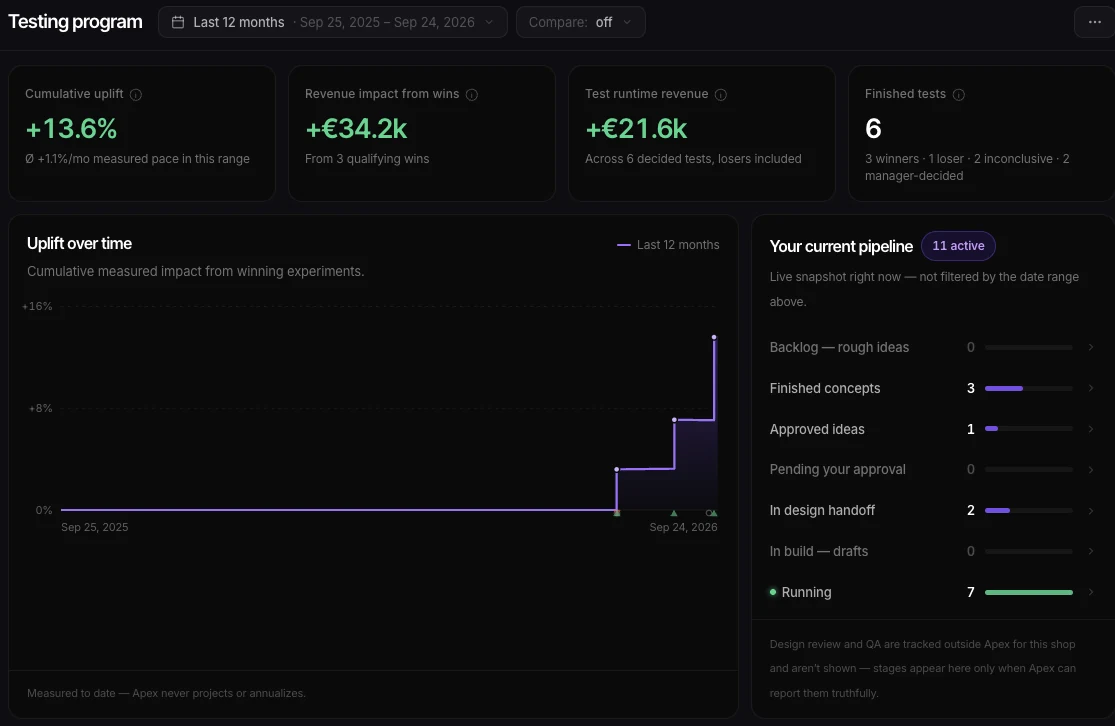
Testing program in Apex: cumulative uplift, revenue impact from wins, test runtime revenue and the running pipeline
+6.5%+6.5%+6.5%Purchases, mobile product selection
Purchases, mobile product selection
+6.5%+6.5%+6.5%
Purchases, application-time matrix¹
+3.2%+3.2%+3.2%
Experiments live within the first month
444

¹ The application-time matrix was classified as a winner through a manager decision. Each percentage shows the purchase uplift against its respective control. The uplifts should not be added together.

The short version

A growing DTC beauty-tech brand wanted a more systematic approach to shop optimization. Together, we connected customer research with an ongoing testing roadmap. Two practical decision aids showed positive results: a compact application-time overview and mobile product selection based on shoppers' priorities.

The starting point of the beauty-tech brand

The team was already eager to test. They had tried changes themselves and seen some positive results. But experiments were sometimes stopped after just three or four days. Results were documented inconsistently, making earlier tests difficult to revisit.

The buying journey was also complex. A long product detail page, multiple variants and bundles, and a high share of mobile traffic created specific challenges for navigation and decision-making. Campaigns, influencers and seasonal demand added further fluctuations.

The challenge

Which changes actually help shoppers buy? And which positive movements are only temporary? Answering those questions required clear hypotheses, traceable results and enough time for each experiment to run.

The content challenge was equally specific. Shoppers needed to understand the price, what results to expect and how the application would fit into their daily routine. Those questions became the basis for optimization.

Our process

The work became a research-backed testing system that compounds.

DRIP's method in three steps, and what each step looked like at the beauty-tech brand.

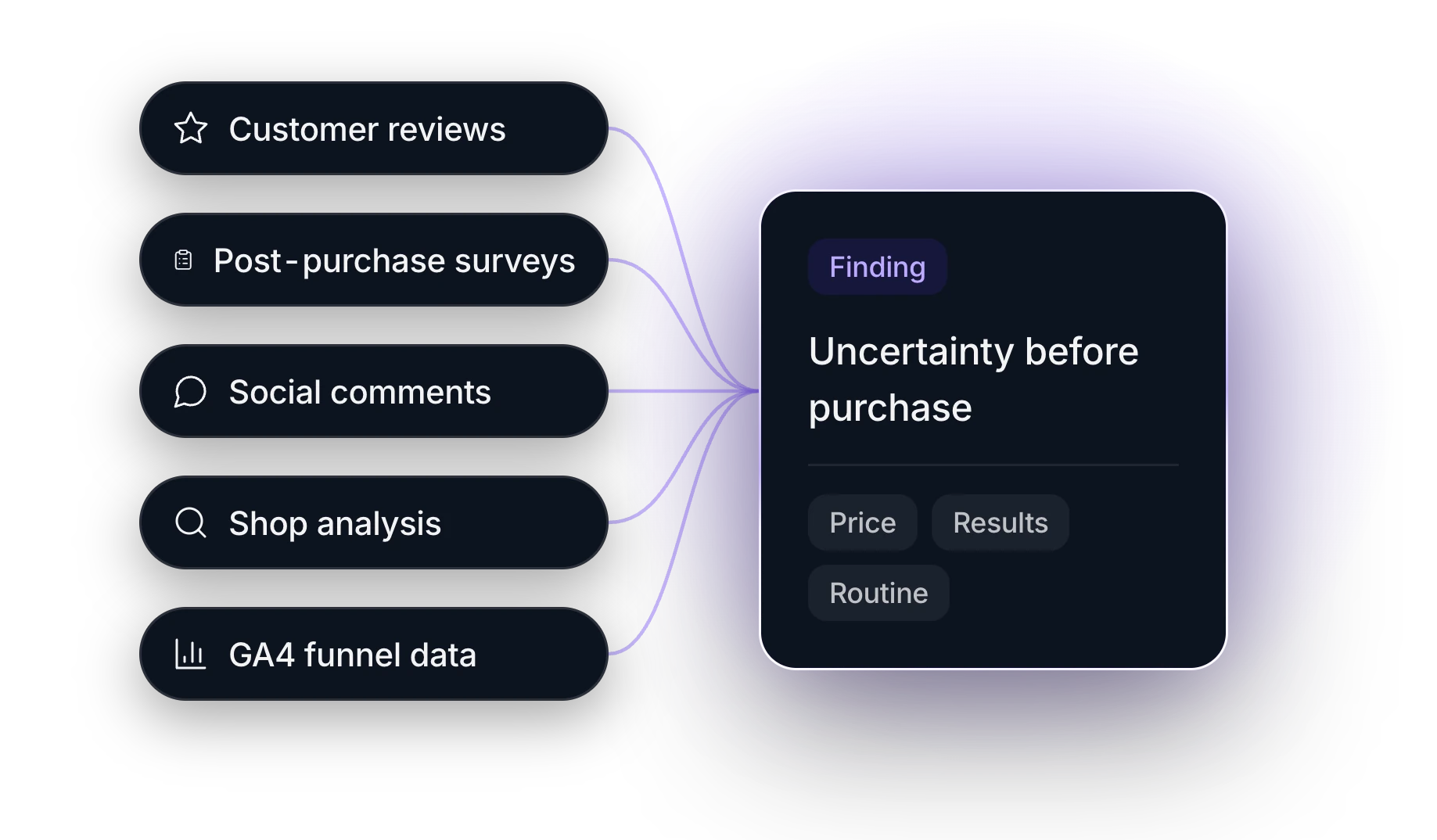
  1. Schematic: customer reviews, post-purchase surveys, social comments, shop analysis and GA4 funnel data lead to one finding: uncertainty before purchase (price, results, routine)

    Step 1

    Research

    Understand what makes the buying decision difficult

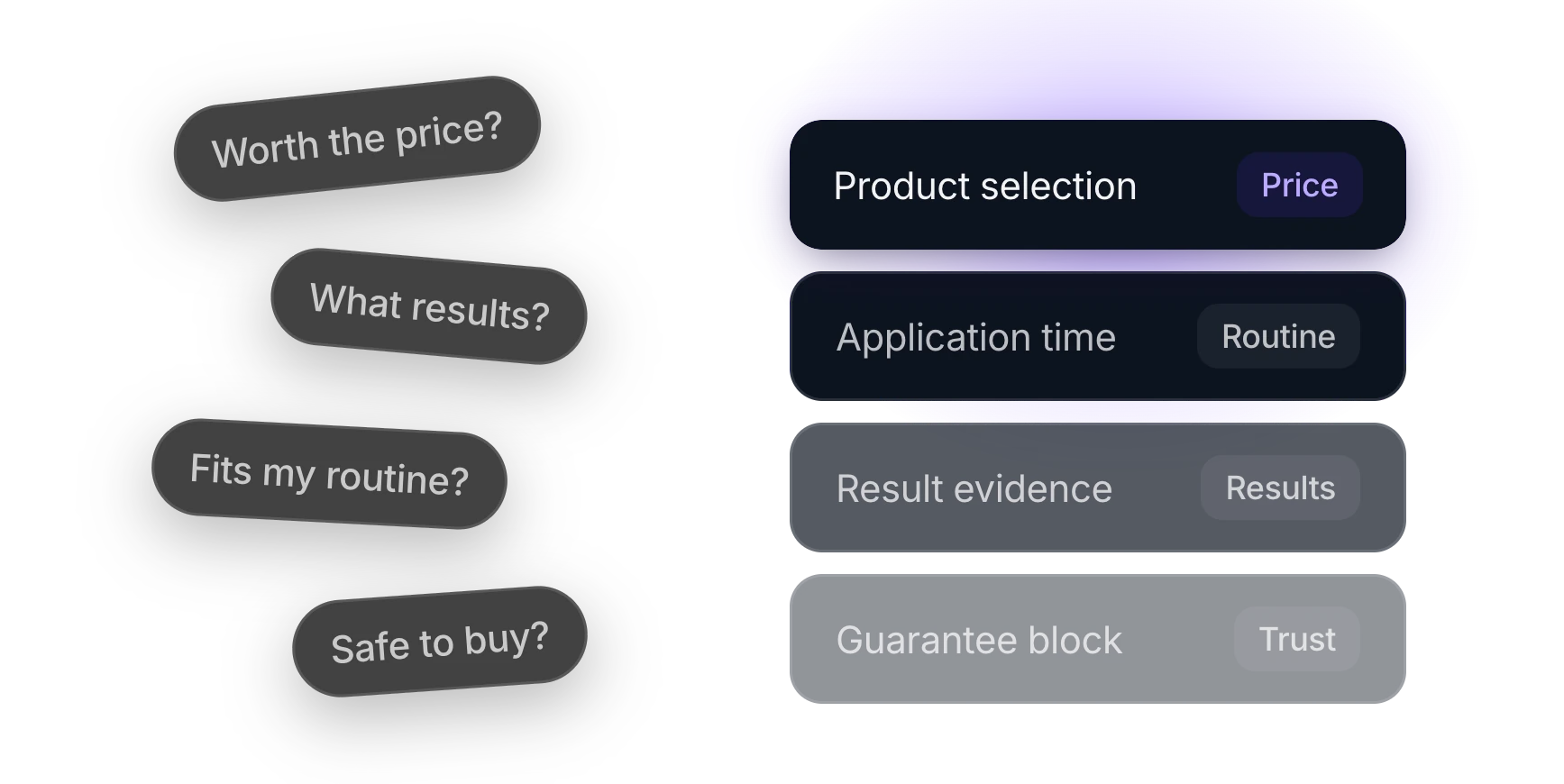
  2. Schematic: four customer questions become a ranked roadmap: product selection, application time, result evidence, guarantee block

    Step 2

    Hypotheses and prioritization

    Turn insights into testable changes

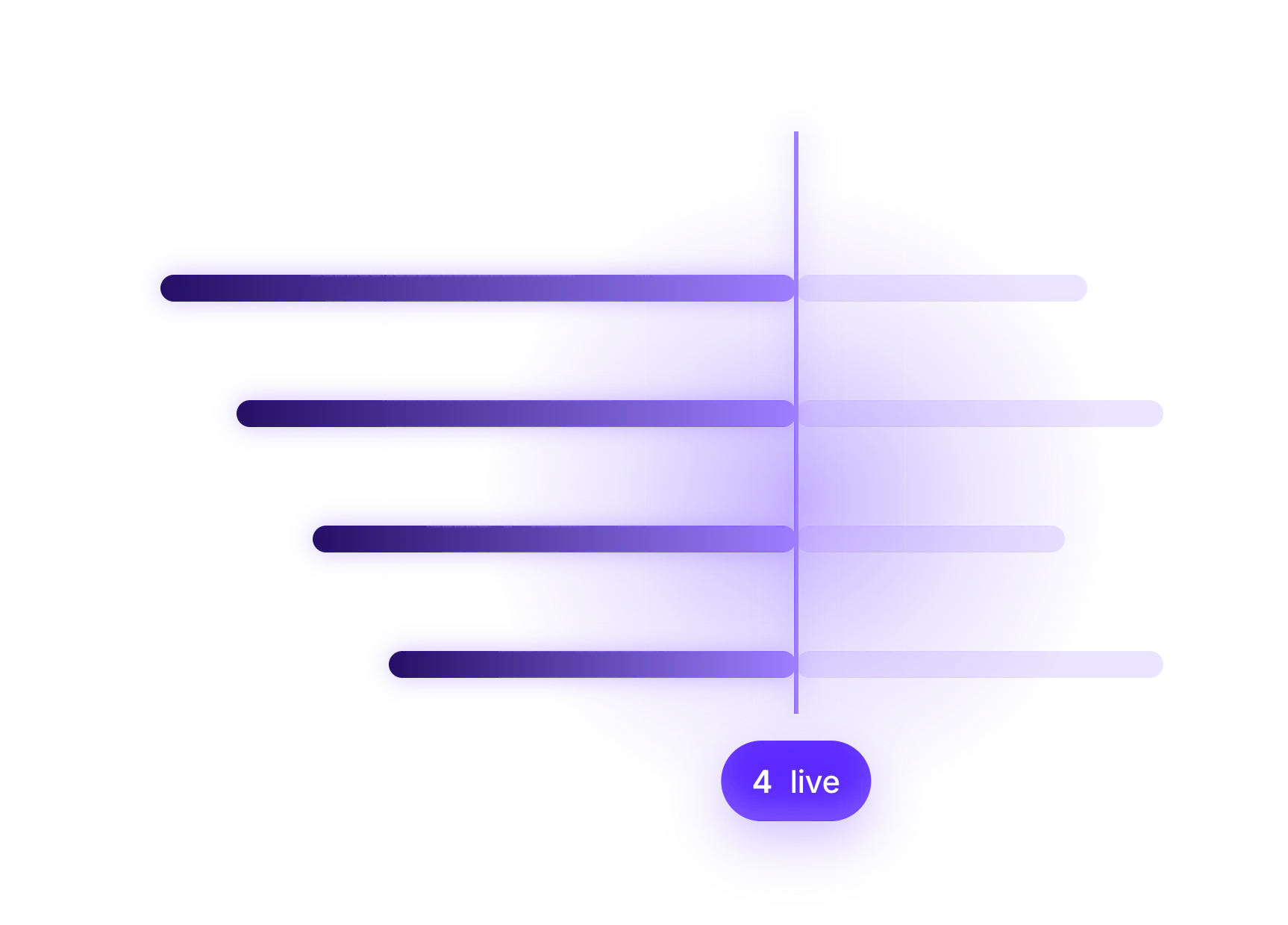
  3. Schematic: four experiments live in parallel on a four-week timeline

    Step 3

    Parallel testing

    Multiple experiments with a clear process

Step 1

Research

Understand what makes the buying decision difficult

We brought together customer reviews, post-purchase surveys, social media comments and shop analyses. Qualitative and quantitative funnel data, along with a GA4 analysis, added context.

The central pattern was a combination of price concerns, uncertainty about effectiveness and a lack of concrete supporting evidence. That gave the roadmap four priorities: explain the value, clarify expected results, reduce perceived purchase risk and make application easier to plan.

Schematic: customer reviews, post-purchase surveys, social comments, shop analysis and GA4 funnel data lead to one finding: uncertainty before purchase (price, results, routine)

Input

Customer feedback and behavior

Reviews, surveys, comments and funnel data showed which questions remained unanswered before purchase.

Insight

Uncertainty had several causes

Price, expected results and application needed to be considered together.

Output

Specific test hypotheses

Customer questions shaped a roadmap for clearer information and better decision support.

Step 2

Hypotheses and prioritization

Turn insights into testable changes

Each experiment had a clear hypothesis and documented variants. The roadmap connected customer research, shop data and previous test results. That made it clear which uncertainty a change addressed and how its success would be measured.

Weekly reviews used the results recorded in Apex to decide whether to adopt a change, stop it or develop another variant. Looking at mobile and desktop separately helped reveal differences in buying behavior.

Schematic: four customer questions become a ranked roadmap: product selection, application time, result evidence, guarantee block

Hypothesis

A customer question behind each change

Every test addressed a specific obstacle in the buying decision.

Evaluation

Look at the full funnel

Clicks alone were not enough. Purchases, revenue and revenue per visitor informed the evaluation.

Iteration

Feed results back into the roadmap

Positive, negative and inconclusive results improved the next hypothesis.

Step 3

Parallel testing

Multiple experiments with a clear process

Four experiments were running in parallel within the first month. A consistent process covering design, development and quality assurance brought the variants into the shop. Longer runtimes replaced decisions made after only a few days.

The focus was on specific changes in the buying journey: clearer application information, easier product selection and more focused trust messaging. Each variant was evaluated in an experiment before it could become a permanent change.

Schematic: four experiments live in parallel on a four-week timeline

Scope

Specific changes in the shop

Tests addressed individual questions and obstacles in the purchase journey.

Build

Design, development and QA

Documented variants and quality assurance kept implementation traceable.

Decide

Give experiments enough time

Evaluation considered the downstream funnel and differences between devices.

What the research found

Four questions shaped the roadmap. They generated the test ideas, and experiments showed which answers helped shoppers in practice.

What it meant for the roadmap

  1. 1

    Is the product worth the price?

    Make the benefits and differences between product options easy to understand.

  2. 2

    What results can I expect?

    Bring specific product information and credible supporting evidence into the buying decision.

  3. 3

    How confident do I feel about buying?

    Place trust information deliberately and test its effect.

  4. 4

    How does application fit into my routine?

    Make the time commitment concrete and easier to plan.

What the actual tests looked like

Two positive results and one negative test show why practical decision support needs controlled experimentation. The first two show the results in Apex; the third visual is schematic.

Test 1 of 3

Make application time concrete

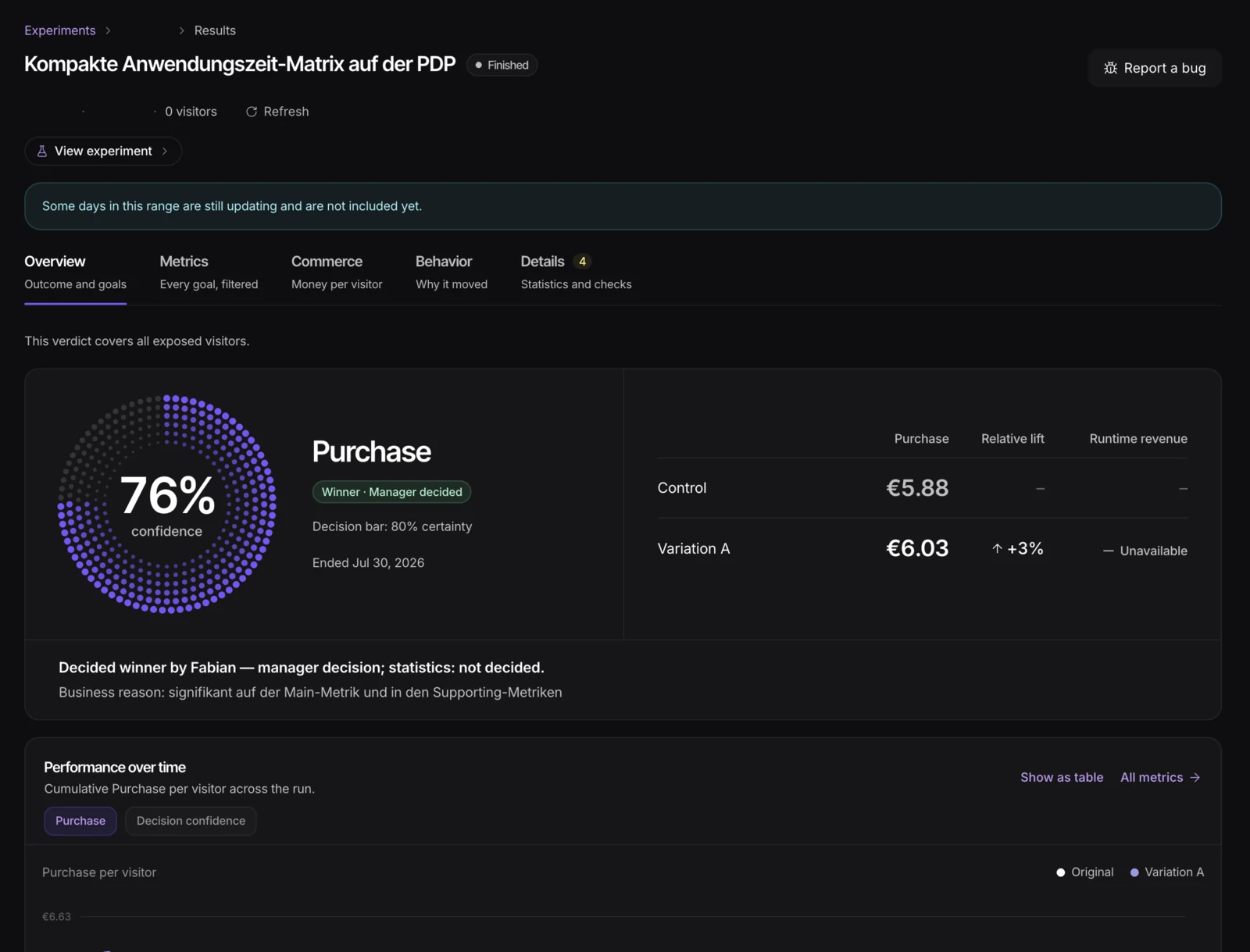
How long does application take? The variant replaced a general statement with a compact matrix showing application times for different areas. This helped shoppers judge the time commitment more precisely. The tested code was subsequently handed over for permanent implementation.

+3.2% purchases versus controlManager-decided winner in Apex
Test result in Apex: compact application-time matrix on the product page, variant against control
Result

Test 2 of 3

Mobile product selection based on personal priorities

The variant let mobile shoppers choose between application time, value for money and the overall package. It highlighted the matching product option while keeping the other options visible. This supported different purchase priorities.

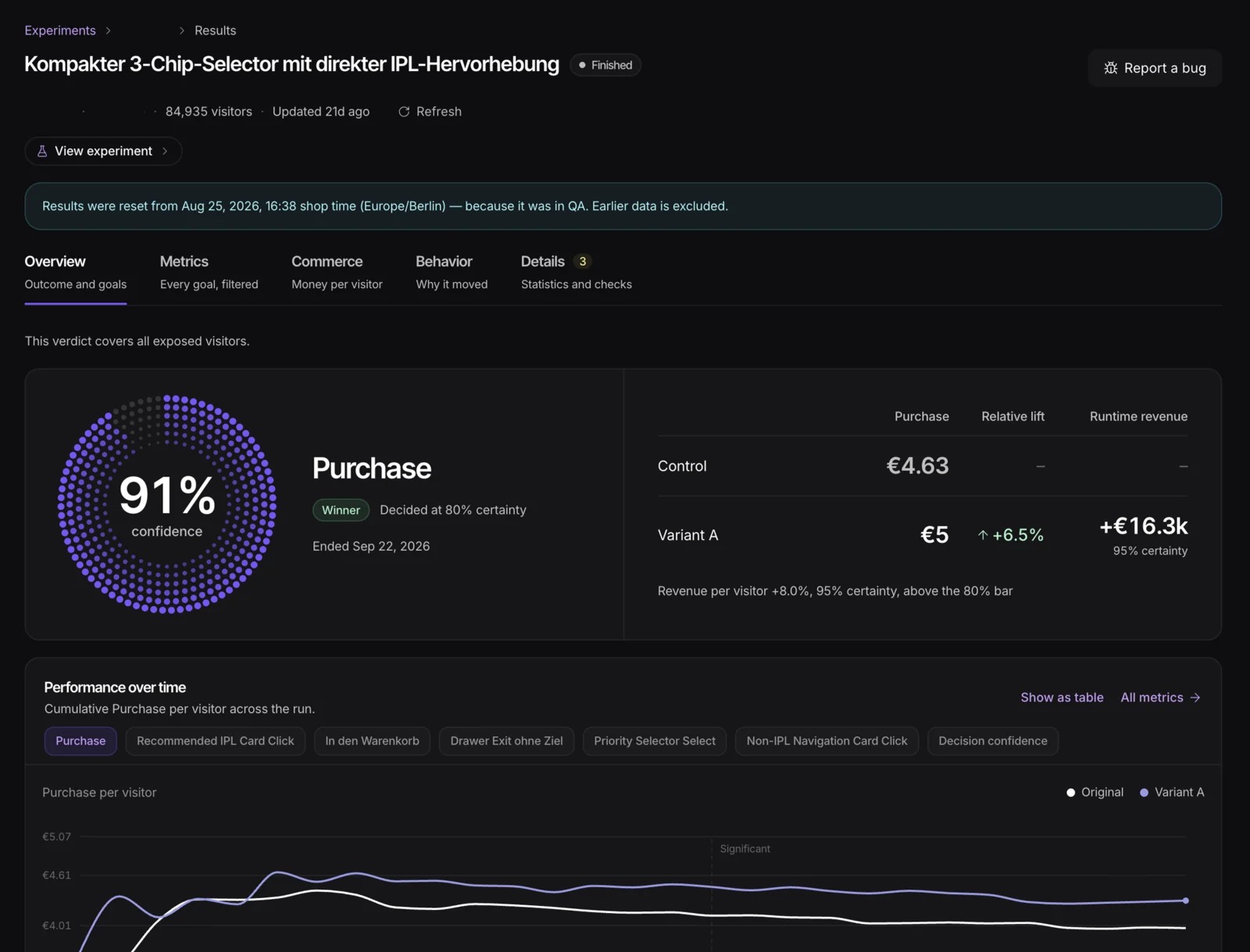
+6.5% purchases versus controlWinner in Apex
Test result in Apex: compact product selector with a highlighted recommendation, variant against control
Result

Test 3 of 3

Test more prominent guarantee messaging

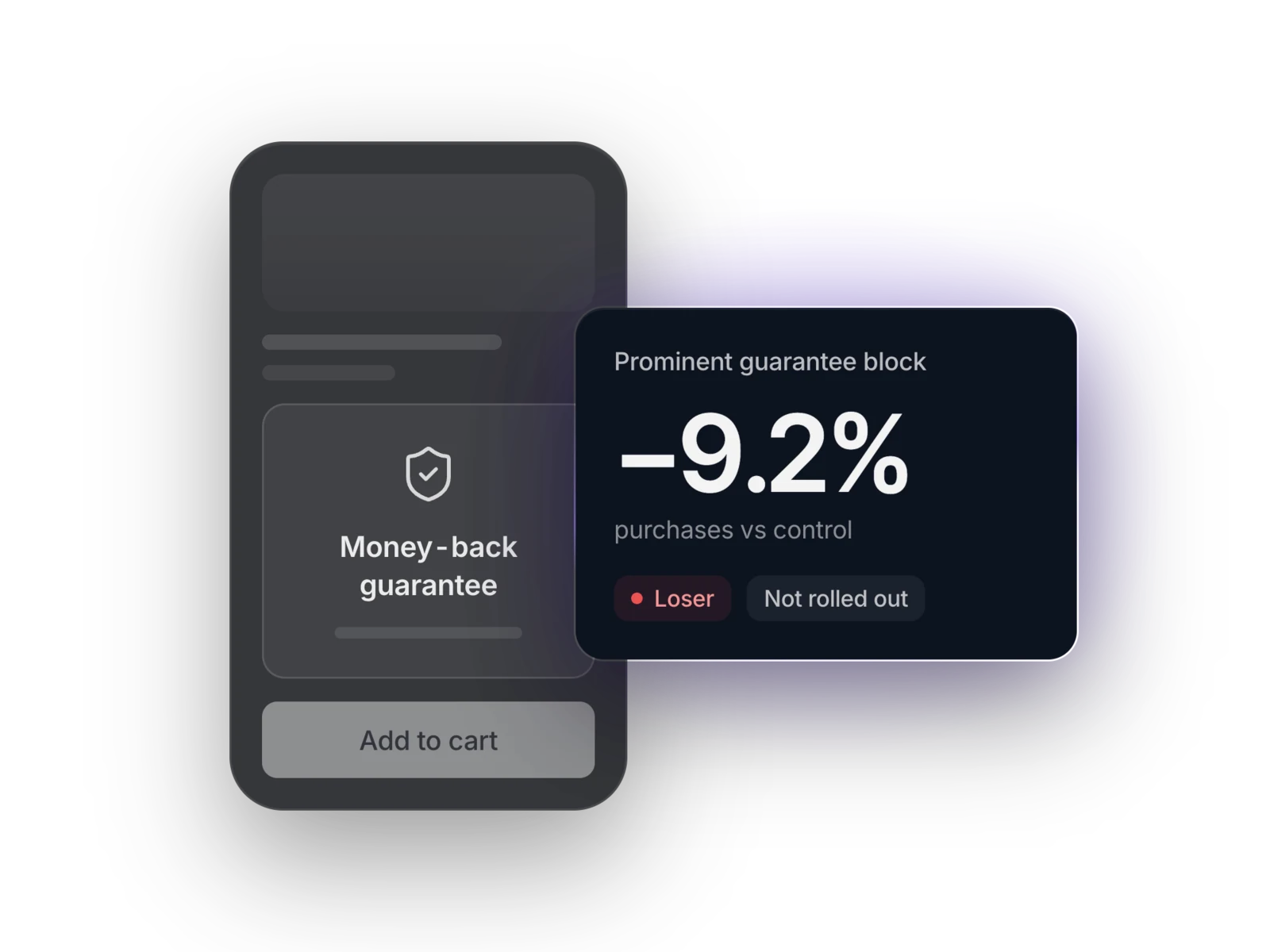
A more prominent money-back guarantee was intended to reduce perceived purchase risk. Instead, the experiment reduced the purchase rate. The variant was stopped and was not permanently implemented. The result informed a new direction for the roadmap: build confidence through more concise trust cues.

−9.2% purchases versus controlLoser in Apex, not rolled out
Schematic: prominent guarantee block, minus 9.2% purchases versus control, not rolled out
Schematic

How Apex supported the decisions

A shared view of results and next steps

Apex made the experiment pipeline and outcomes visible in one place. The team could distinguish running tests from decided results and see which experiments were marked as winners, losers or inconclusive. Manager decisions were labeled separately.

The mobile product-selection experiment was classified as a winner with 6.5% more purchases. The application-time matrix showed a 3.2% uplift and was classified as a winner through a manager decision. A more prominent guarantee reduced purchases by 9.2% and was not rolled out. Together, these results informed what to adopt, what to stop and what to test next.

The value extended beyond finding positive changes. Testing exposed a harmful variant before it became a permanent shop change. The result then informed a more focused approach to trust messaging.

Apexby DRIP
  • Mobile product selection

    Priority-based choice on mobile

    +6.5%Winner
  • Application-time matrix

    Tested code handed over for permanent implementation

    +3.2%Winner, manager decision
  • Prominent guarantee block

    Stopped, not rolled out

    −9.2%Loser
Selected experiments tracked in Apex. Schematic presentation. Each value is the purchase uplift against that test's own control; the values are not added together.

Overall impact

Mobile product selection delivered a 6.5% purchase uplift. The compact application-time matrix showed 3.2% more purchases and was classified as a winner through a manager decision. Testing also prevented the negative guarantee variant from becoming a permanent shop change.

DRIP's research and testing process, with pipeline and outcome visibility in Apex, gave the team a clearer basis for follow-up decisions. Each result contributed to the next round of optimization.

The takeaway

For this beauty-tech brand, clearer application information and product selection based on personal priorities showed positive results. More prominent guarantee messaging reduced purchase performance.

Customer questions set the direction. Controlled experiments test the implementation. Apex keeps the pipeline and outcomes visible so the team can use each result to make the next decision.

DRIP and Apex

Spend the same on ads.
Make more from them.

Book a call with the team and tell us about your shop. We'll talk through where it stands, where you want it to go, and how we'd get you there. If working with us isn't the best return on your money, we'd tell you rather than take it.

See if your shop is a fit

30 minutes, and you'll know exactly where your shop stands.

More case studies

SNOCKS

€8.2M+ additional revenue

How SNOCKS scaled from €2M to €90M a year

Read case study →
KoRo

€2.56M in 6 months

How KoRo added €2.56M in 6 months by turning first-time A/B testing into a research engine

Read case study →
Kickz

3.6× conversion rate

How Kickz went from 0.59% to 2.7% conversion rate in 3 years

Read case study →

The Newsletter Read by Employees from Brands like

LEGONikeTeslalululemonPelotonSamsungBoseIKEA

Join 17,000+ Ecom founders turning CRO insights into revenue

Trusted by 250+ brands

  • Strauss
  • Koro
  • Sunday Natural
  • The Body Shop
  • Grover
  • Hello Fresh
  • Natural Elements
  • AG1
  • Bluebrixx
  • Woom
  • Hornbach
  • Tourlane
  • Congstar
  • Holy
  • Junglück
  • PV
  • Wunschgutschein
  • Motel A Mino
  • Ryzon
  • Kickz
  • The Female Company
  • Livefresh
  • Schiesser
  • Horizn Studios
  • Seeberger
  • Luca Faloni
  • Zahnheld
  • Snocks
  • Bruna
  • NatureHeart
  • Priwatt
  • Jumbo
  • NKM
  • Oceansapart
  • Omhu
  • Blackroll
  • 1 Kom Ma 5
  • Purelei
  • Giesswein
  • T1tan
  • Buah
  • Ironmaxx
  • Waterdrop
  • Send a Friend
  • Fitjeans
  • Mofakult
  • Plantura
  • BGA
  • Coop
DRIP / Apex

Prediction-based experimentation for online shops from €100k a month.

See if your shop is a fit

Company

  • About us
  • Case studies
  • Process
  • Careers
  • Experts
  • Media
  • Reviews

Services

  • Done for you
  • Done with you
  • CRO agency
  • A/B testing agency
  • Shopify CRO

Apex

  • Apex
  • How we built the genome
  • Log in
  • Docs

Resources

  • Blog
  • Resources
  • Research
  • Benchmarks
  • Statistics tools
  • Best A/B testing tools
© 2026 Drip Trading GmbH
ImprintPrivacyTerms

Cookies

We use optional analytics and marketing cookies to improve performance and measure campaigns. Privacy Policy