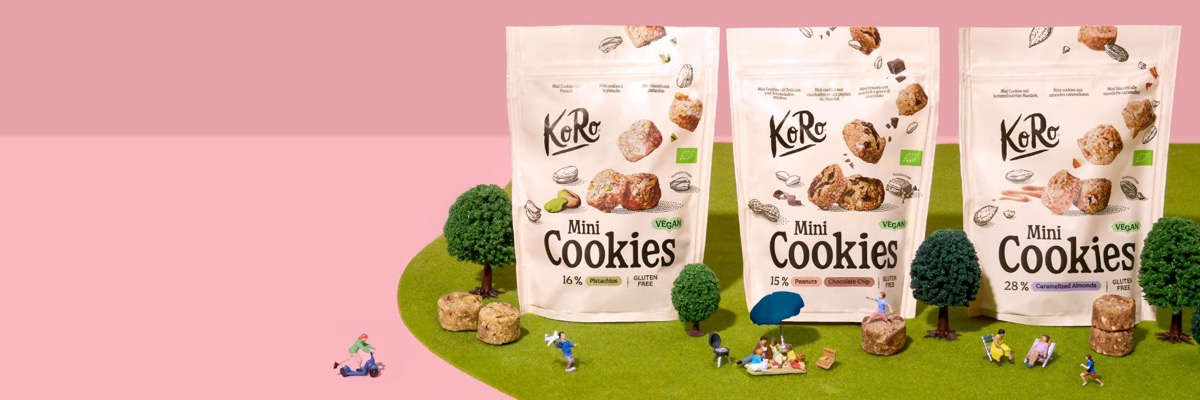
The current shop already had strong assets. The job was to make them convert harder.
How KoRo added €2.56M in 6 months.
A first structured testing program built from predictive consumer research, rapid A/B testing, and iterative prioritization, lifting session conversion rate by 10%.
KoRo was already a €250M+ European food and snack brand when DRIP started the CRO program, but the store had never run structured A/B testing. We built the system from zero: predictive consumer research to understand bulk-food buying anxiety, rapid A/B testing across PDP, PLP, cart, and checkout, and iterative prioritization through Research Hub. In six months, KoRo increased session conversion rate by 10%, lifted total revenue by 7%, and added €2,555,643.72 without increasing ad spend.
Research did not stay abstract. It became visible work.
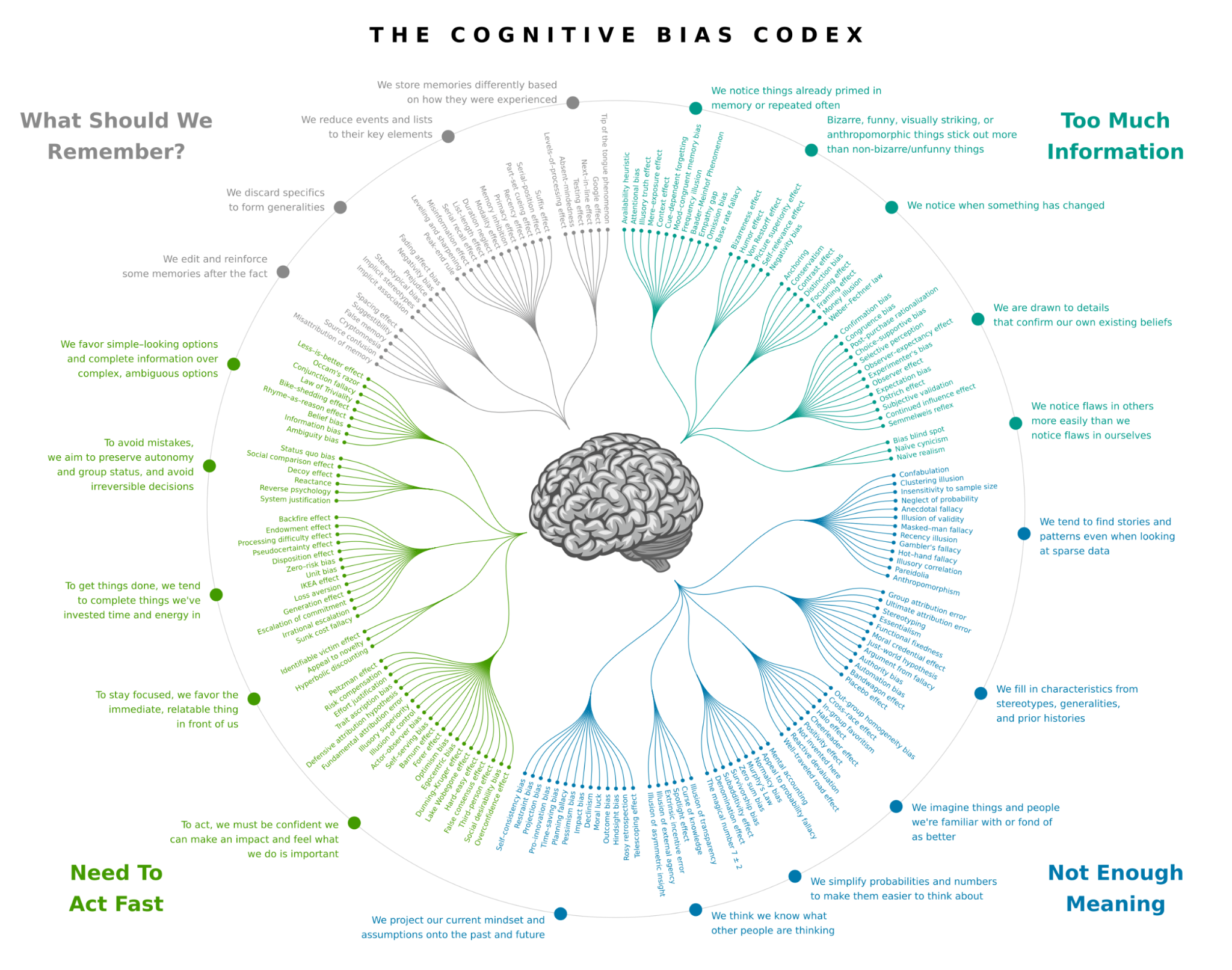
Each case-study layer now keeps the artifacts in the page: current shop screenshots, research boards, prioritization outputs, test evidence, and impact charts.
Funnel data, heatmaps, and attention scores pointed to the same problem: effort was too expensive.
We translated customer psychology into a prioritized testing roadmap.
The first testing program created immediate revenue and a reusable decision system.
The first testing system had to prove its commercial lift fast.
KoRo needed evidence that CRO could become a growth channel, not a one-off optimization project.
Why KoRo needed a sharper growth system.
KoRo is a Berlin-based food retailer and DTC brand known for nuts, nut butters, dried fruit, protein snacks, pantry staples, and larger value packs. The brand had strong demand, a broad catalogue, a Certified B Corp position, and a large returning customer base.
That scale made the opportunity unusually valuable. Small lifts on product pages, listing pages, cart, and checkout could move meaningful revenue, but KoRo had no controlled testing system to decide which ideas were actually working.
The buying context was also specific. KoRo customers do not only ask whether a product looks good. They ask whether a large pack is worth committing to, whether it will arrive intact, how long it stays fresh, whether the ingredients match their health goals, and whether the value is obvious before checkout.
The current shop already had strong assets. The job was to make them convert harder.
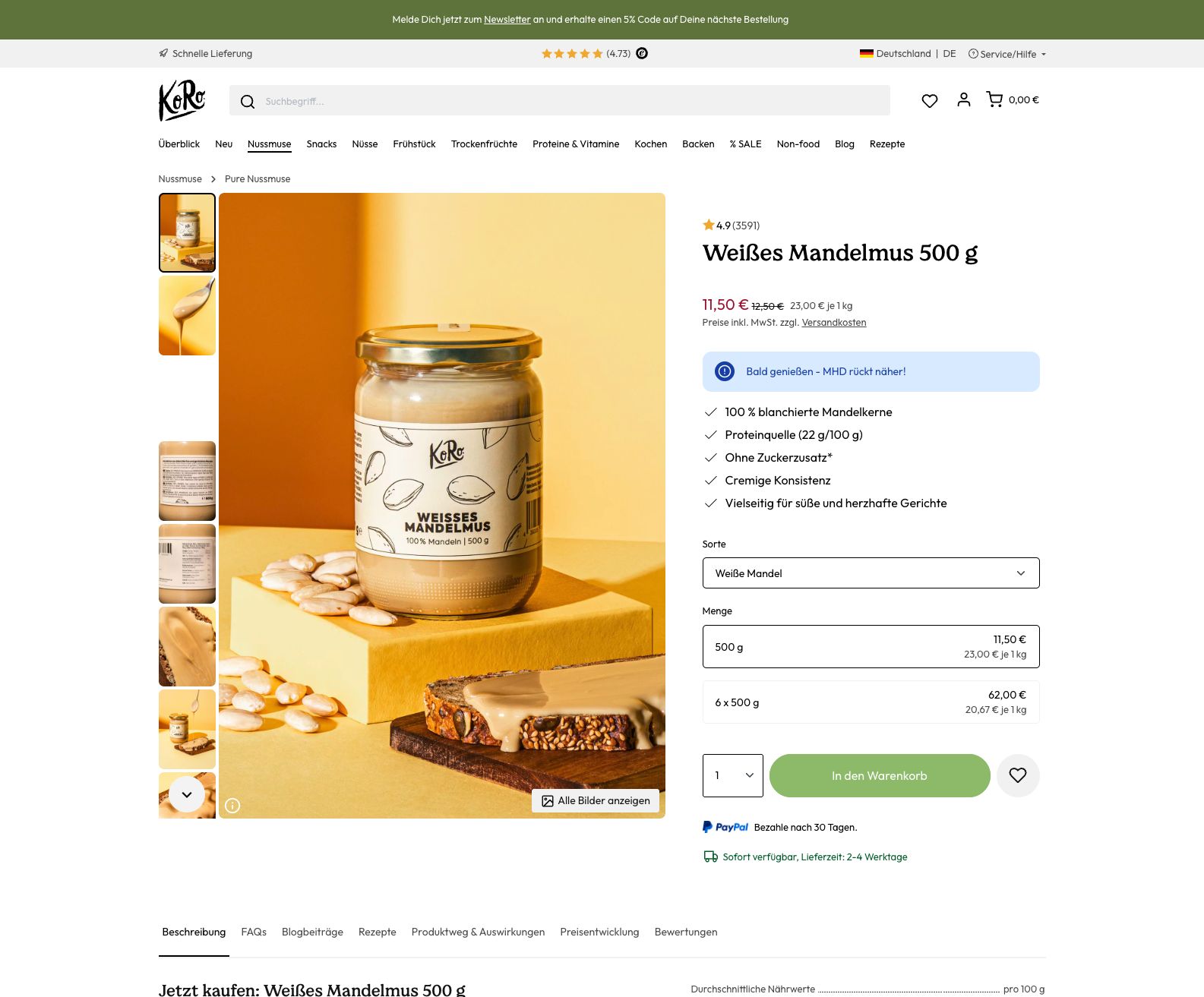
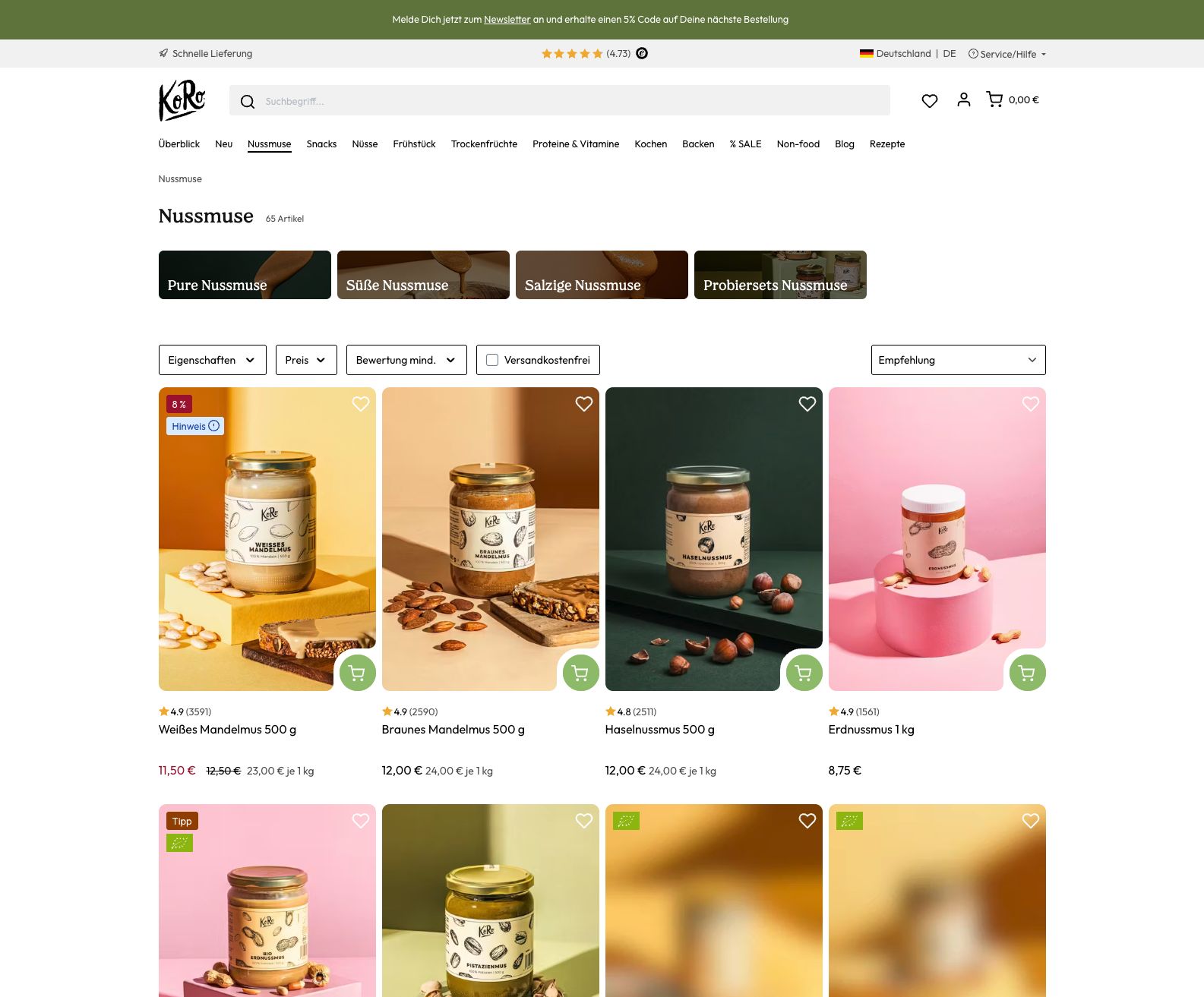
We captured the live KoRo homepage, collection page, and product page so the case study reflects the current 2026 experience, not an outdated PDP screenshot.
The conversion problem behind the headline.
KoRo had high traffic and high brand awareness, but CRO decisions were still mostly driven by internal judgment, competitor references, and isolated analytics views. There was no shared evidence system connecting customer motivations, funnel leaks, test ideas, and commercial readouts.
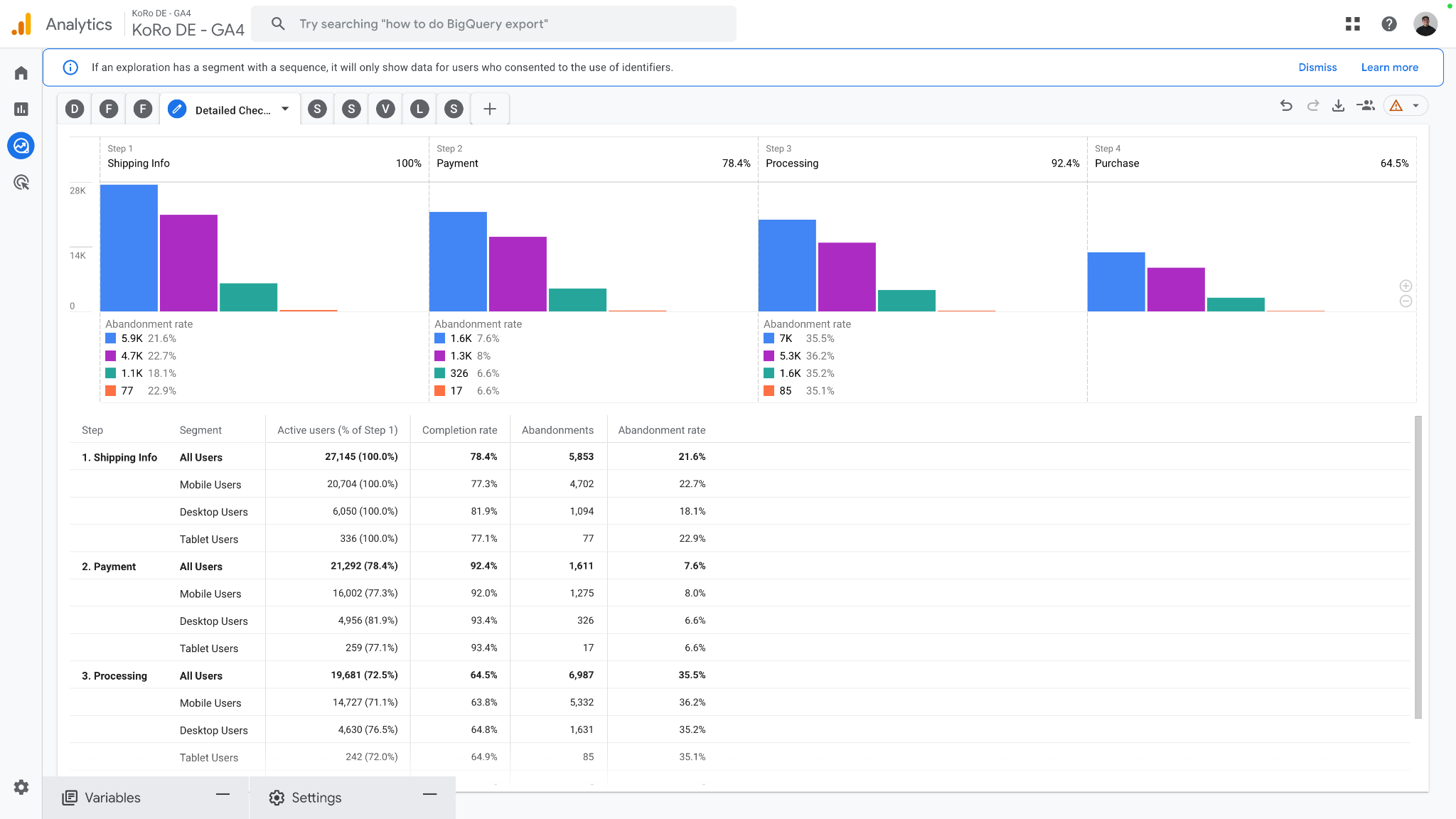
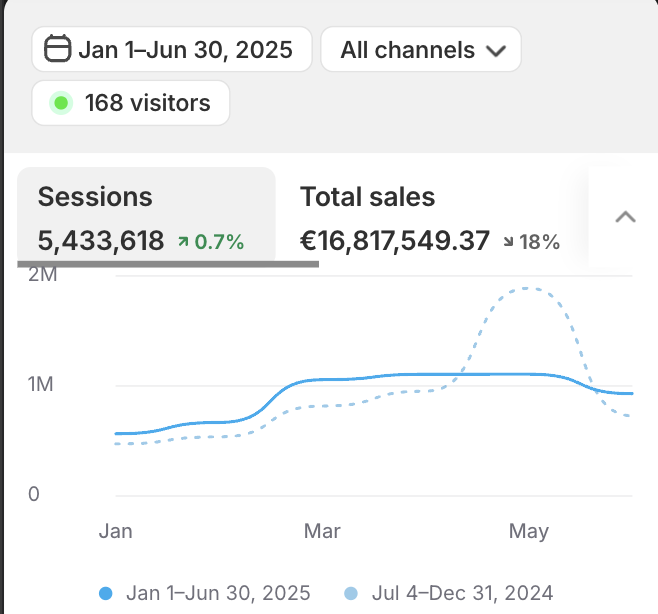
The funnel showed several high-value leaks. The cart abandonment rate was 58.2%, mobile represented 63.6% of traffic, and search users converted 159.18% better while also generating €25.04 higher basket value. That meant the site already contained strong purchase intent, but not every page helped users reach it efficiently.
The strategic challenge was to make the first experimentation program sophisticated from day one. The goal was not to run random cosmetic tests. It was to build a scientific operating system that could predict better ideas, test them quickly, and keep learning after every result.
Funnel data, heatmaps, and attention scores pointed to the same problem: effort was too expensive.
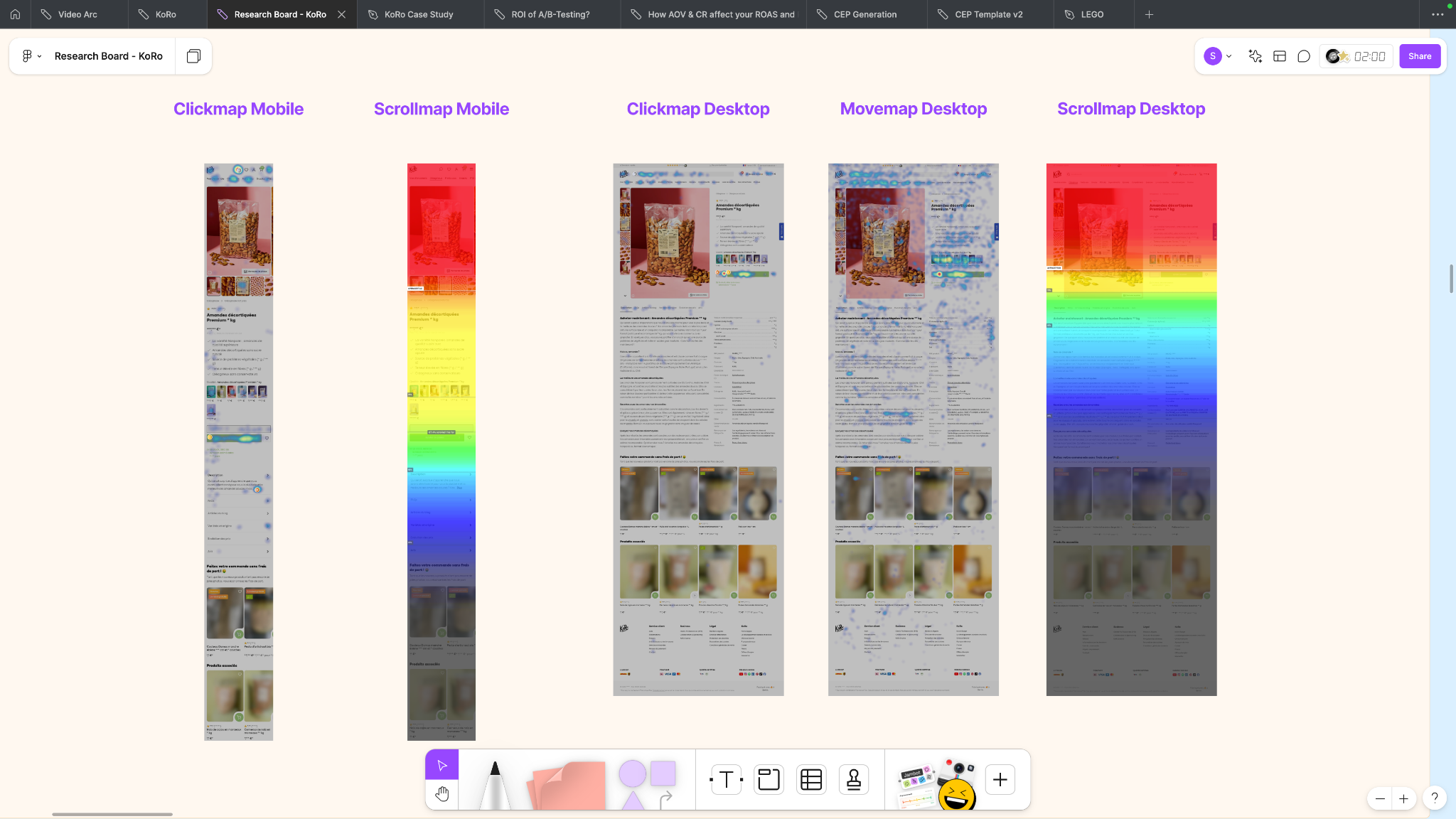
The research layer connected analytics, heatmaps, session recordings, and Attention Insight scoring. The result was a clearer view of where buyers were ready to purchase and where the page still made them work too hard.
The work became a research-backed testing system.
We used the DRIP Growth Protocol as the working model: increase the quality of test ideas through predictive consumer research, increase the rate of testing through parallel A/B experimentation, and increase the success rate through iterative prioritization.
Predictive research combined Research Hub analyses, GA funnel data, heatmaps, session recordings, search behavior, review mining, and attention modeling. The strongest signals were Security, Comfort, and Progress: shoppers wanted safe delivery, low-risk bulk purchases, clear shelf-life expectations, and a faster path to products that matched their taste and health goals.
Those signals became experiments across the full funnel. PDP copy reduced cognitive load around product benefits. PLP layout changes put products higher above the fold. Checkout tests removed unnecessary form effort. Cart concepts tested whether progress, shipping thresholds, and free-gift mechanics could help without adding mobile clutter.
We translated customer psychology into a prioritized testing roadmap.
KoRo did not need a single redesign. It needed a loop that could convert customer evidence into hypotheses, experiments, readouts, and the next priority.
How we made KoRo's first testing program behave like a research engine
The KoRo program followed the three activities in the DRIP thesis: predictive consumer research, rapid A/B testing, and iterative prioritization. Research made the hypotheses sharper, testing made the learning faster, and prioritization kept the roadmap tied to revenue exposure instead of opinion.
Model bulk-food purchase risk before choosing page changes
Run focused tests across PDP, PLP, cart, checkout, and search-adjacent surfaces
Rank ideas by revenue exposure, research strength, effort, and test learnings
Every validated change raises the next baseline and teaches the next sprint what to test.
Understand why shoppers hesitate before asking which page element to change.
We combined Research Hub analyses, customer-language mining, funnel data, heatmaps, attention modeling, and more than 40 hours of session recordings. The work showed that KoRo's strongest conversion questions were not abstract brand questions. They were practical risk questions around large pack sizes, delivery integrity, taste confidence, shelf life, and whether the product matched a health or snack goal.
A good KoRo test had to answer one of the buyer's real risk questions: Will this taste good, arrive safely, stay fresh, fit my routine, and justify the larger pack?
Reviews, analytics, heatmaps, search behavior, session recordings, and Research Hub reports were pulled into one evidence base.
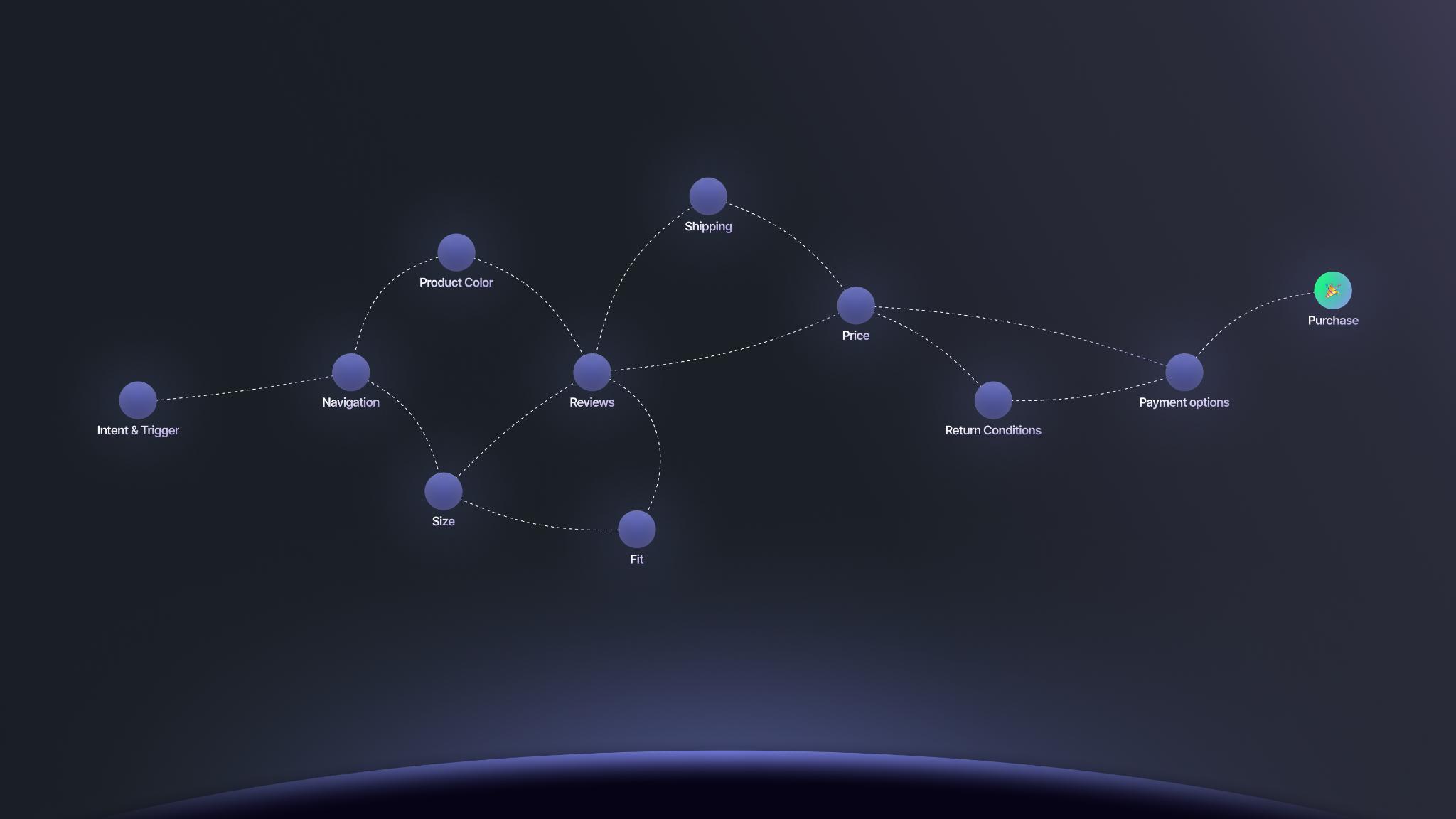
We grouped the evidence into taste, pack-size, delivery, freshness, health, price-value, and checkout effort risks.
Every experiment was tied to a behavioral mechanism such as cognitive ease, risk reduction, goal-gradient effect, or value perception.
Turn research into a portfolio of tests instead of waiting for one large redesign.
Research Hub tracked 18 KoRo experiments across the high-exposure funnel. The first winners were intentionally narrow: rewrite PDP information to reduce cognitive load, shrink PLP category overviews to expose products faster, and remove optional checkout fields that asked users to do unnecessary work.
The strongest early wins came from making existing intent easier to complete. KoRo did not need louder persuasion first. It needed less effort between motivation and purchase.
Each test started from a named friction point, behavioral mechanism, page surface, and expected metric effect.
Variants were designed, implemented, QA'd, and launched with a clear readout plan.
Results were interpreted commercially and behaviorally so the next test could become sharper.
Keep the roadmap moving toward the biggest commercial and behavioral questions.
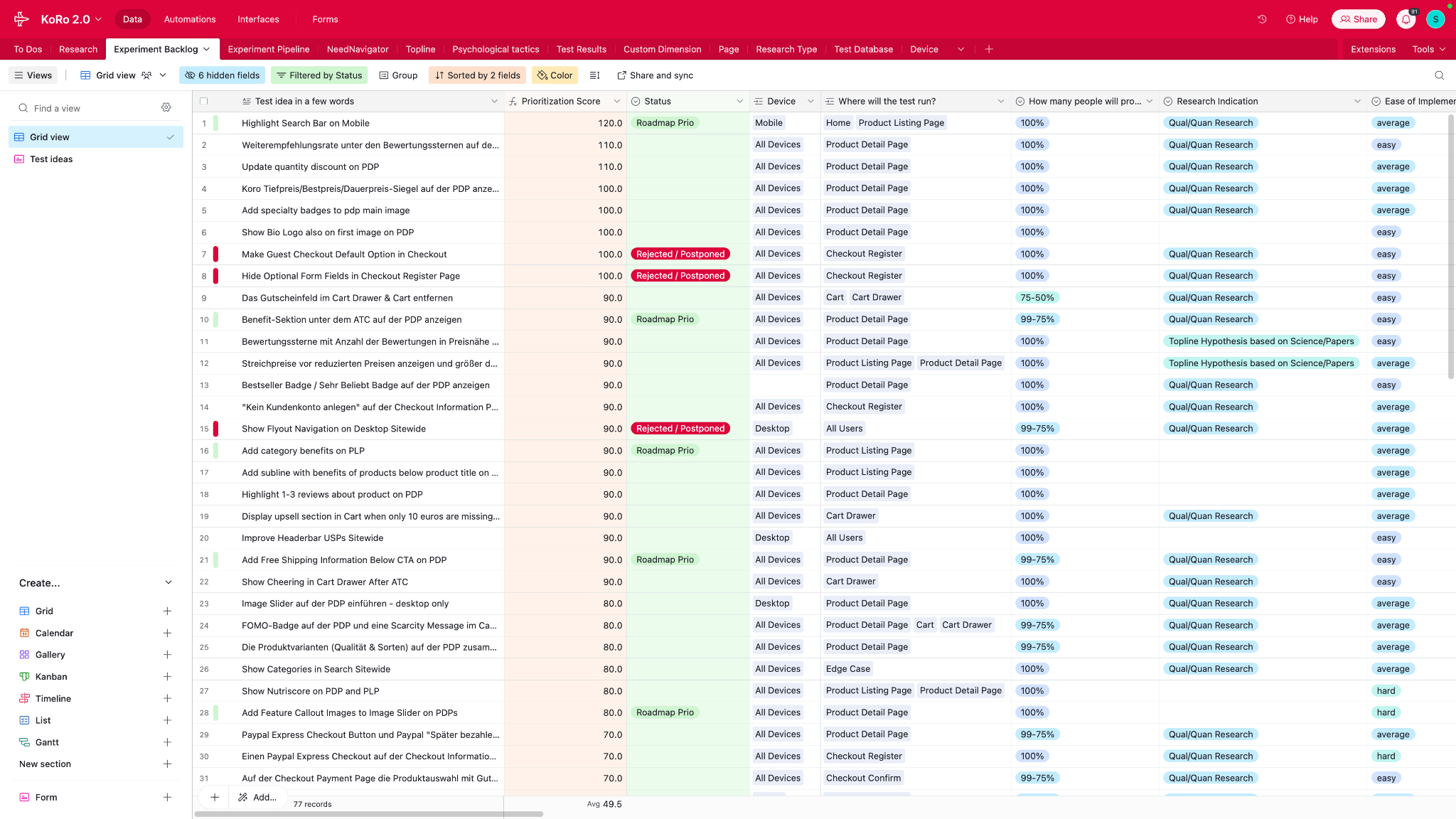
The backlog was not a static idea list. We scored ideas by traffic, revenue exposure, ease of implementation, customer evidence, Research Hub indicators, and what previous tests had already taught us. The system made it clear when to double down on PDP clarity, when to move to checkout friction, and when a cart idea needed another iteration before rollout.
The highest-value output was not only the winning variant. It was KoRo's new ability to make future CRO decisions with a shared evidence base.
Ideas were scored by page exposure, expected impact, confidence, ease, and research indication.
PDP, PLP, cart, and checkout ideas were sequenced based on where the next revenue constraint appeared.
Every test result changed the roadmap, even when the variant did not become a rollout.
58.2% of users abandoned cart and 63.6% of traffic was mobile.
Small amounts of cognitive or physical effort on mobile could carry a large revenue penalty.Search users converted 159.18% better and generated €25.04 higher basket value.
Search was a high-intent behavior, but desktop made the route more obvious than mobile.Research Hub scored Security 86, Comfort 81, and Progress 74 as the strongest purchase drivers.
KoRo buyers needed safe arrival, low-risk bulk commitment, freshness clarity, and health-goal fit.Finished Attention Insight studies showed strong PDP focus while home and collection clarity still had room to improve.
Visual focus was not the same as purchase confidence. The next layer was reducing interpretation effort.Predictive research output: what KoRo customers cared about most
Research Hub feature extraction showed that KoRo conversion was driven by practical confidence: safe delivery, great taste, pack-size commitment, quality consistency, service trust, and delivery speed.
Shipping and transport packaging integrity
TrustCustomers cared strongly about whether glass, bags, powders, and bulk goods arrived intact and reliably packaged.
Taste and deliciousness
Core ProductTaste carried the strongest positive sentiment and gave PDP copy a clear reason to make expectation-setting more scannable.
Pack sizes and commitment risk
Trial RiskBulk packs created value, but also raised the cost of being wrong for first-time shoppers.
Product quality consistency
QualityRepeat customers expected consistency across batches, flavors, texture, and freshness.
Customer service
TrustService quality helped reduce the risk of damaged shipments, wrong products, or delivery questions.
Delivery speed
ConvenienceSpeed mattered most once customers had already decided to stock up or needed pantry items soon.
What the actual tests looked like.
The page keeps the real control, variant, and result screenshots so the case study shows the evidence behind each claim.
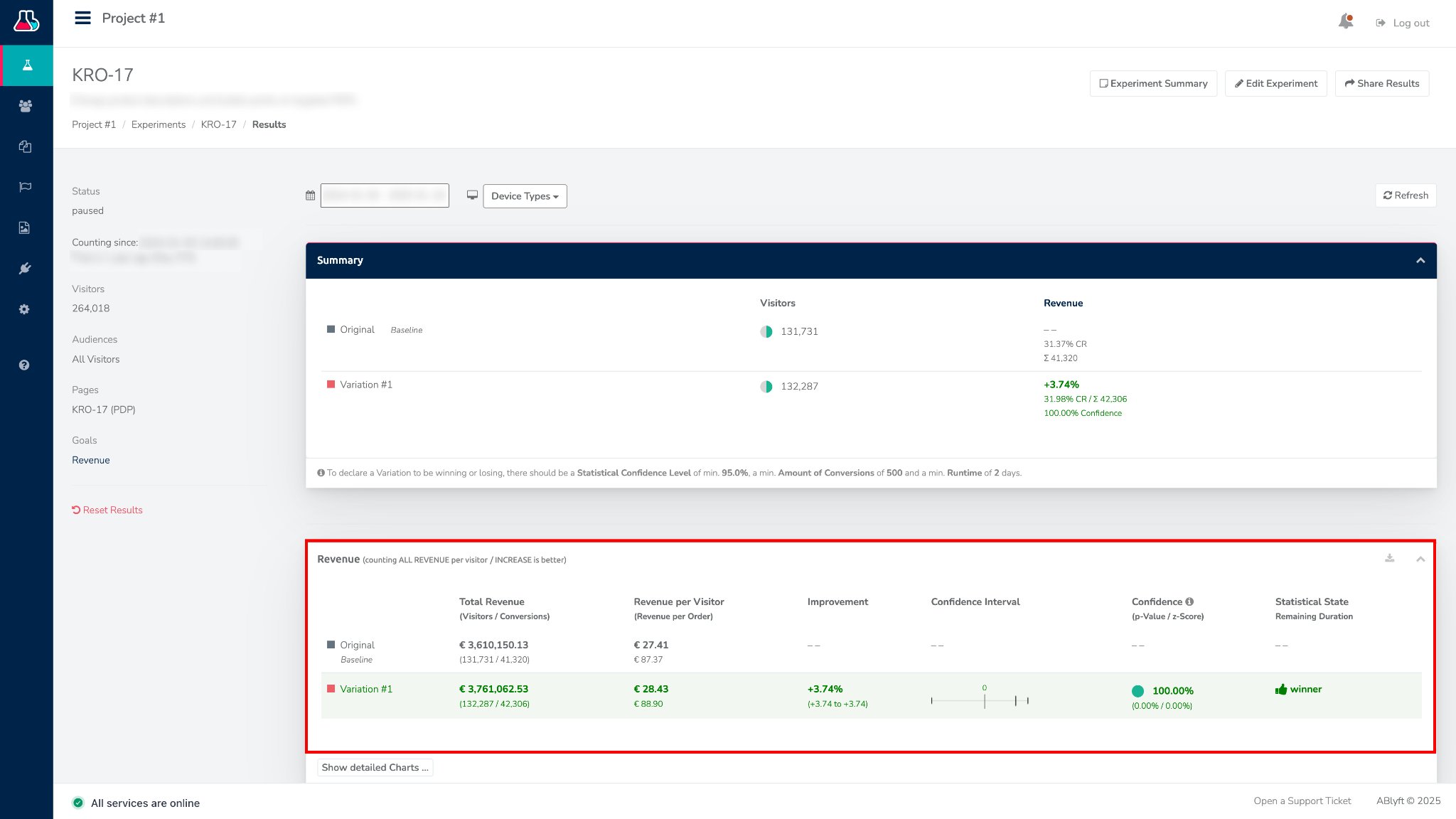
KRO-17: Rewrite PDP Product Descriptions and Bullet Points
We rewrote targeted product-page descriptions and bullet points so shoppers could understand benefits, taste expectations, and usage faster. The mechanism was cognitive ease plus value perception: reduce the work required to decide whether a larger food purchase is worth committing to.
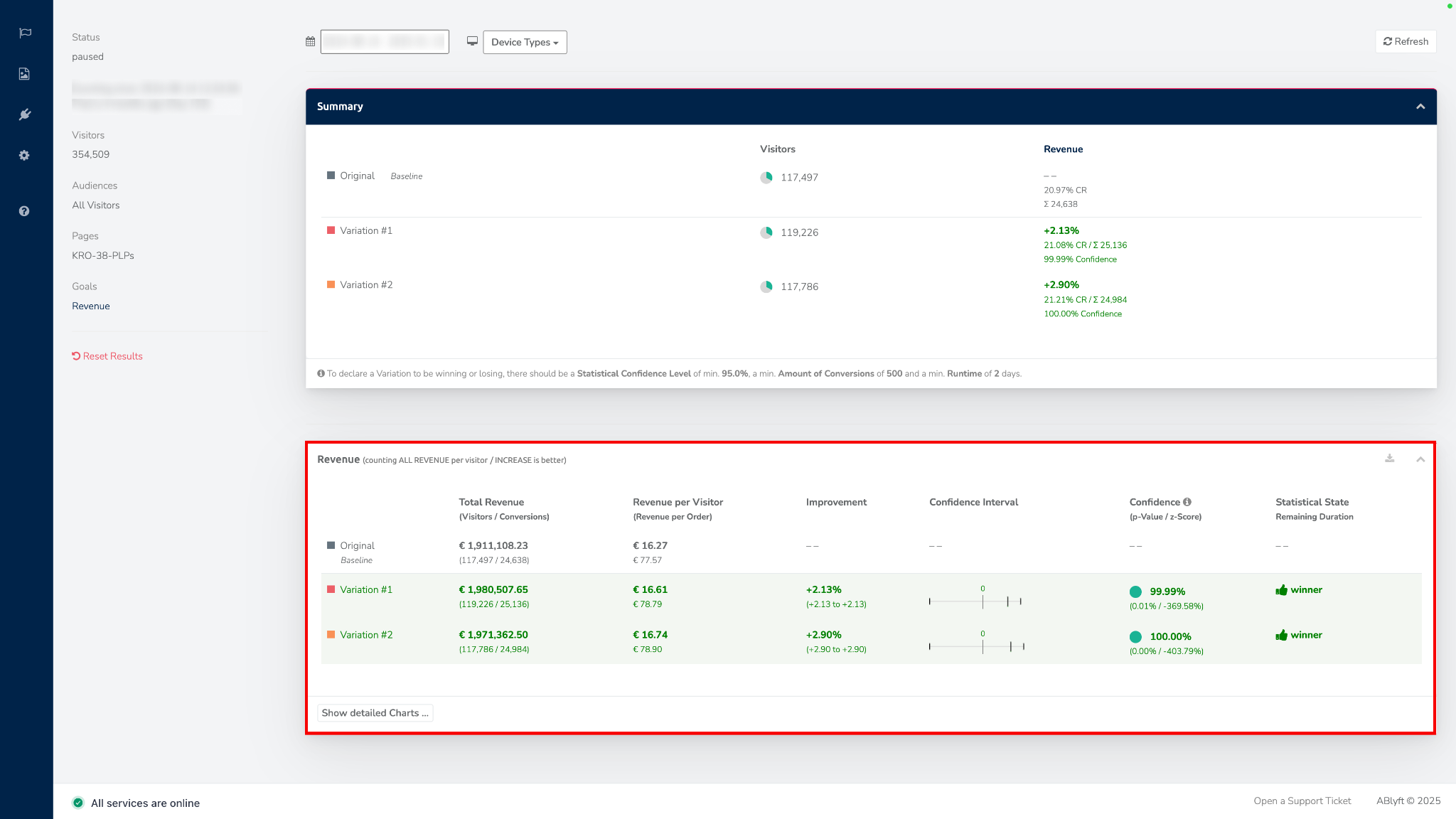
KRO-38: Make the Category Overview on PLPs Smaller
The collection page was carrying too much explanatory weight above the product grid. We reduced the category overview so users could reach products faster and compare options with less scrolling.
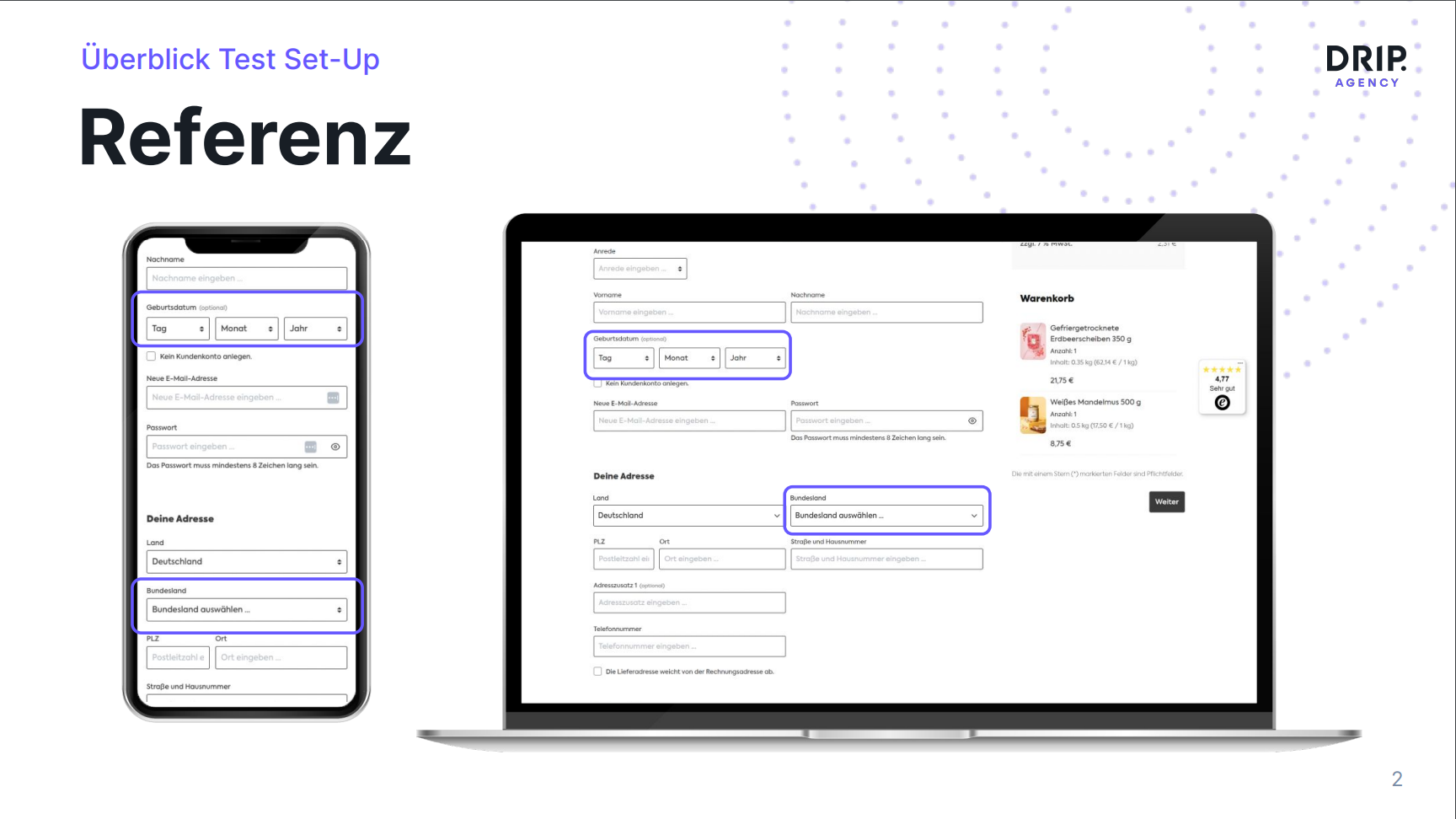
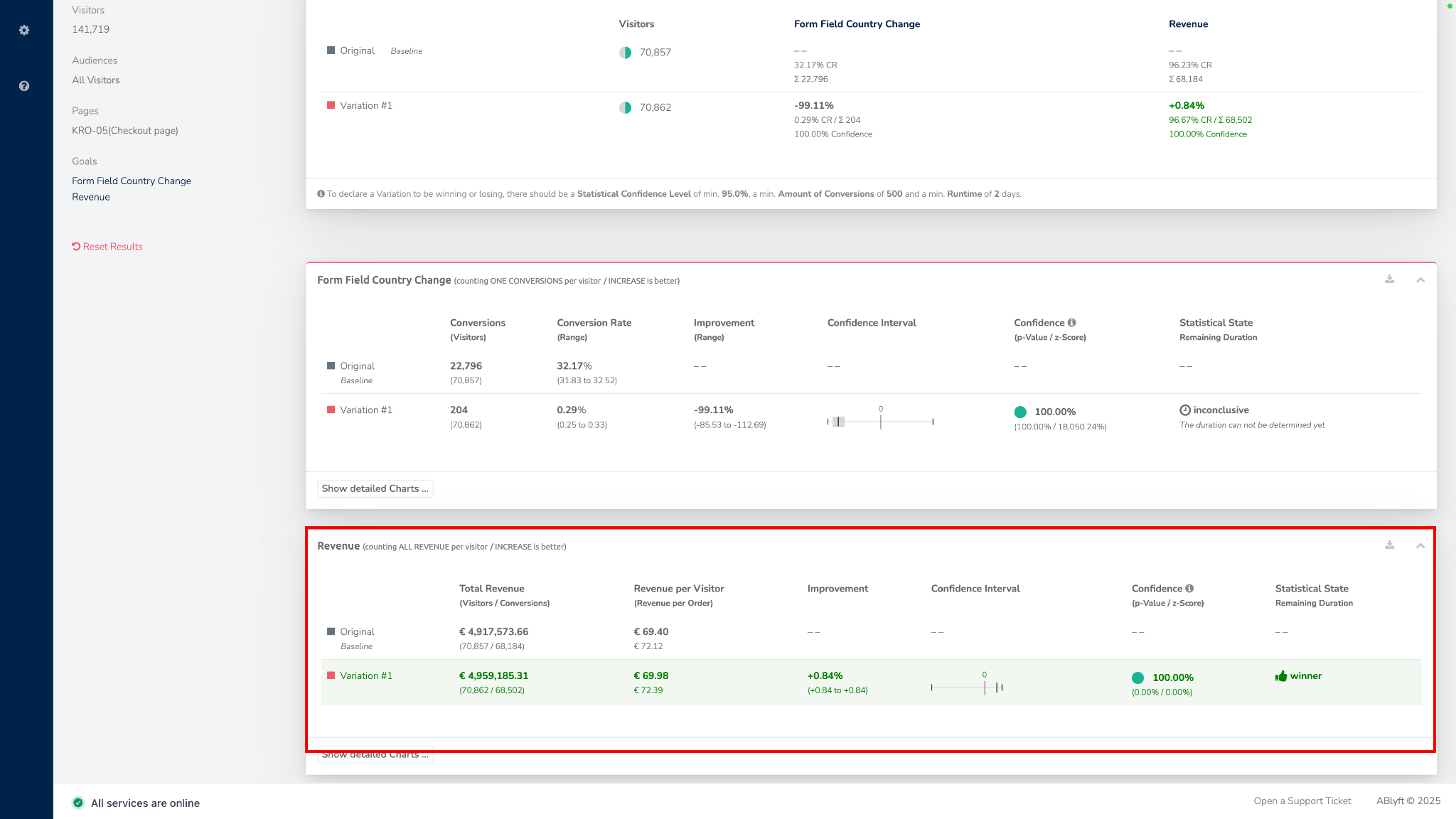
KRO-05: Remove Low-Value Checkout Form Fields
We reduced checkout effort by removing or moving optional fields such as birthdate and state selection, while keeping the shipping path clear. The test targeted physical effort, cognitive effort, and form fatigue.
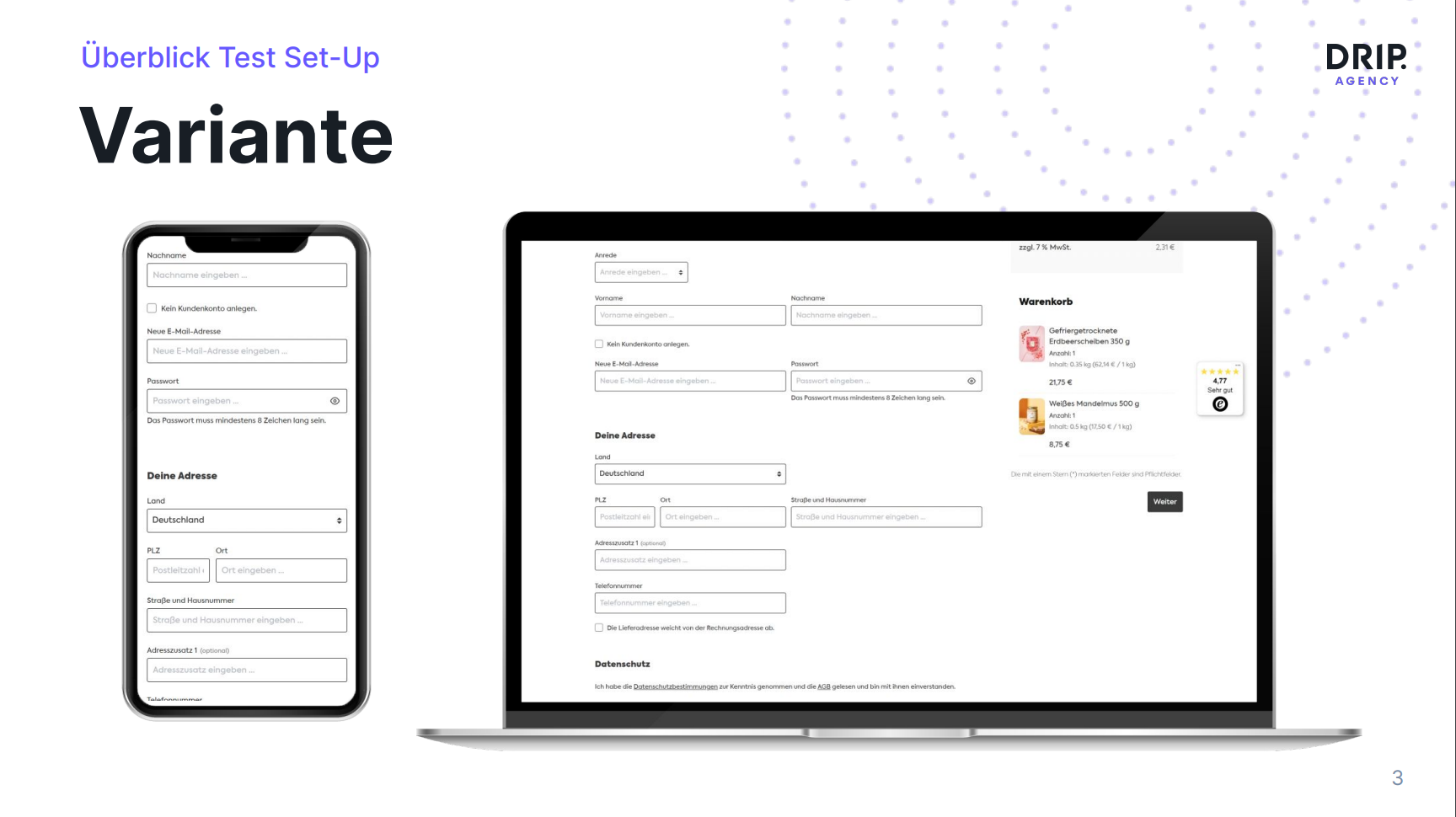
KRO-64: Optimize Shipping Form and Login Section
We improved the shipping information form and login section so returning and guest users had fewer decision points in a high-intent moment. The test was built from checkout funnel analysis and the same cognitive-ease mechanism as KRO-05.
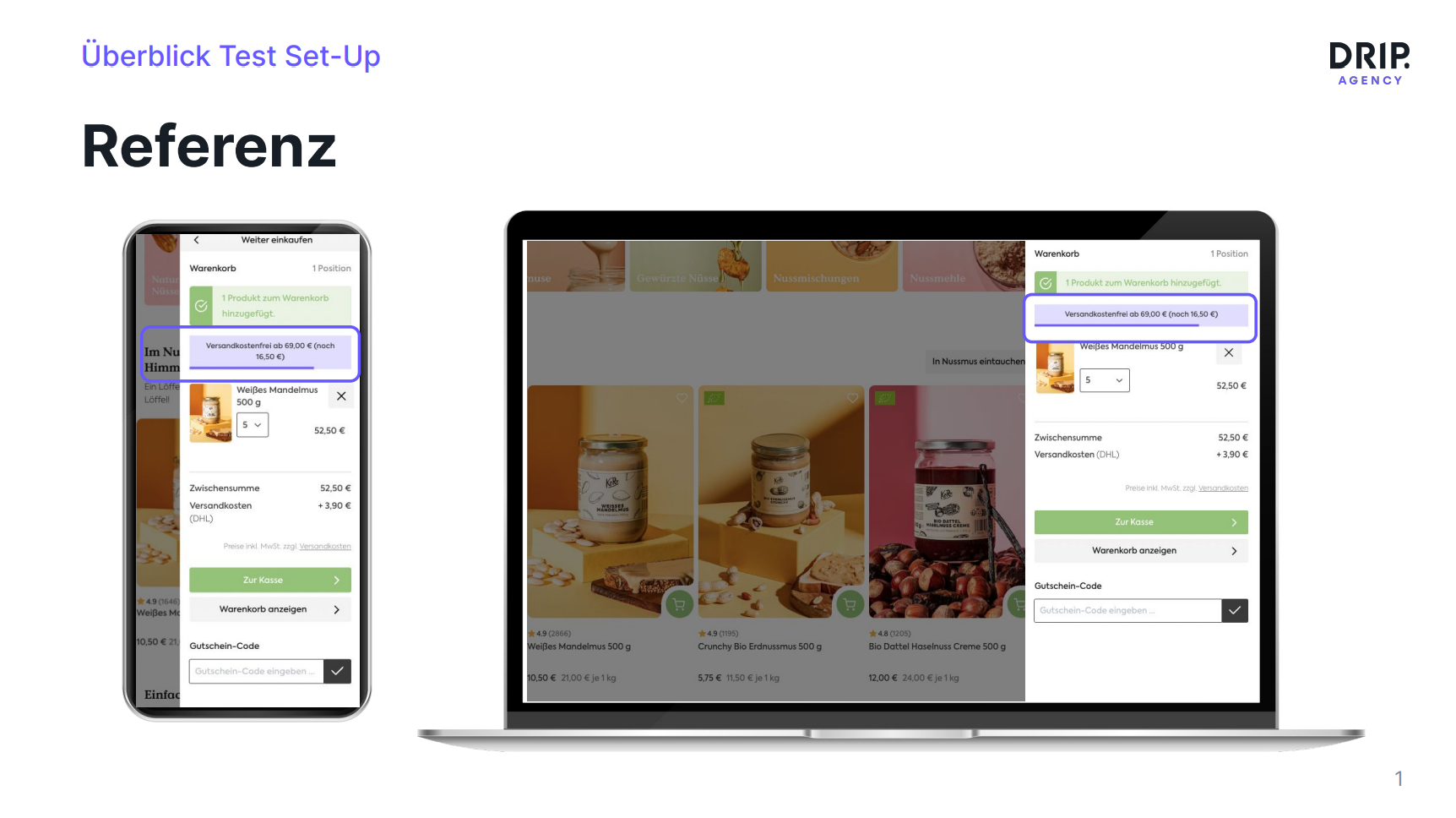
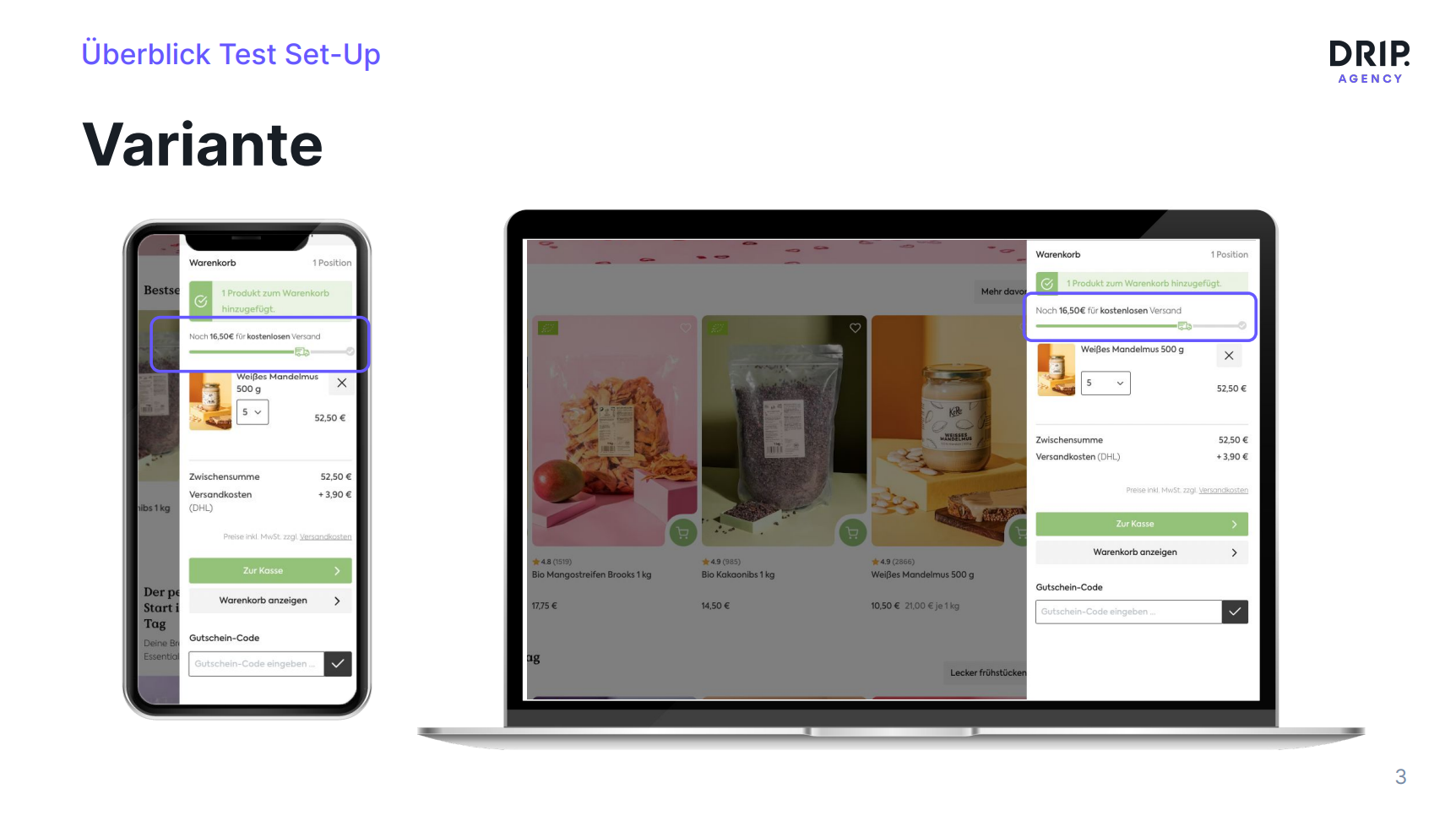
Cart Progress-Bar Iteration: Shipping Threshold Clarity
We also explored cart-progress mechanics inspired by goal-gradient behavior. This idea was useful because it showed where visual motivation could help and where mobile clutter could create the opposite effect.
The output was not a nicer website. It was a better revenue system.
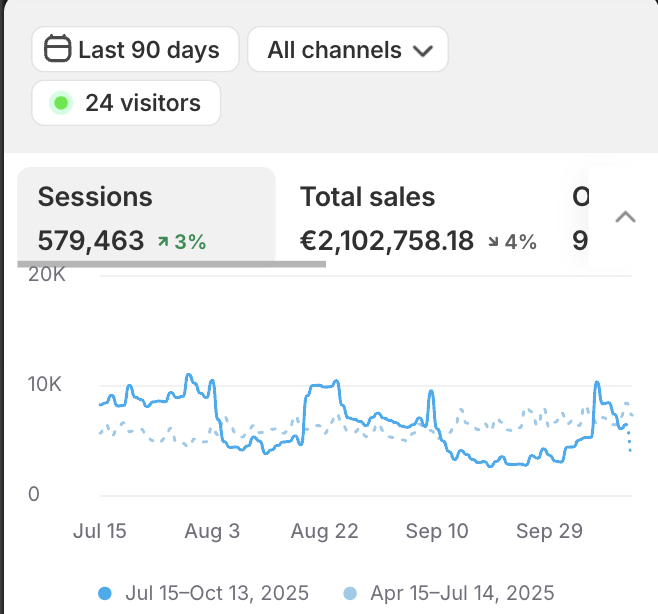
In the first six months, KoRo added €2,555,643.72 in additional revenue, increased session conversion rate by 10%, and lifted total revenue by 7% without increasing ad spend.
The first three validated tests alone generated more than €300,000 in additional runtime revenue. Research Hub now contains 18 KoRo experiment records, including winners across PDP copy, PLP layout, and checkout friction.
The larger result was operational. KoRo went from no structured A/B testing to a working experimentation system: research inputs, hypothesis writing, design and QA, statistical readouts, and a prioritization process that improved after every test.
The advantage came from compounding learning.
KoRo shows why large ecommerce brands can still have enormous CRO upside even after years of growth. Revenue scale does not prove the funnel is optimized; it only makes every hidden friction point more expensive.
The winning ideas were not random UI tweaks. They answered the customer's real buying questions: Is the large pack safe to buy? Will it taste good? Will it arrive intact? Can I find the right product quickly? Is checkout asking me for anything unnecessary?
For complex DTC brands, the advantage comes from building a smarter testing system, not from guessing the next redesign. Predictive research improves idea quality, rapid A/B testing increases learning speed, and iterative prioritization compounds the results.
The first testing program created immediate revenue and a reusable decision system.
The wins were not isolated. PDP copy, PLP scanability, and checkout friction tests all fed the same roadmap logic: reduce risk, reduce effort, and prioritize what touches the largest revenue pools.
More results from the same operating model.
Want Results Like This?
Book a free strategy call and we'll show you what psychology-driven CRO can do for your brand.
The Newsletter Read by Employees from Brands like