Drip
Case StudiesProcessApex
Done for youWe run your testing programDone with youYour team runs it in Apex, with our research
BlogResourcesArtifactsStatistical ToolsBenchmarksResearch
See if your shop is a fit
See if your shop is a fitSee if you're a fit
Strategy7 min read

How to Calculate Your CRO ROI (With Formula)

The math behind CRO investment is simple. A EUR 75K CRO investment on a EUR 50M store can return 66x. Here is how to build the business case.

Fabian GmeindlCo-Founder, DRIP Agency
6 Feb 2026Published
This article is part of The Complete Guide to Conversion Rate Optimization

CRO ROI is calculated as (Incremental Revenue from CRO - CRO Investment) / CRO Investment. For a EUR 50M annual revenue brand that invests an example EUR 75K and achieves a conservative 10% RPU uplift, that translates to EUR 5M in annual incremental revenue and a 66x return on investment. Published client results include a 25.3x program ROI at Giesswein and 13.5x at SendAFriend.

Contents
  1. 01How Do You Calculate the ROI of CRO?
  2. 02What Does a Realistic CRO Investment Look Like?
  3. 03What ROI Have Real Brands Achieved from CRO?
  4. 04Why Does CRO ROI Compound Over Time?
  5. 05How Do You Build a Business Case for CRO Investment?
Reading progress0%
complete

01How Do You Calculate the ROI of CRO?

CRO ROI equals (Incremental Revenue - CRO Investment) divided by CRO Investment. The key variable is incremental revenue, which is your current revenue multiplied by the RPU uplift percentage.

The ROI formula for CRO is the same as any other investment. What makes it unusually compelling is the leverage ratio: a small percentage improvement in Revenue Per User multiplies across every visitor, every day, for the remaining life of the winning change.

The CRO ROI formula

CRO ROI = (Incremental Annual Revenue - CRO Investment) / CRO Investment. Incremental Annual Revenue = Current Annual Revenue x RPU Uplift Percentage. Let us walk through a concrete example.

CRO ROI calculation: worked example
VariableValueNotes
Current annual revenueEUR 50,000,000Online revenue only
CRO investment (example)EUR 75,000DRIP agency license fee
RPU uplift achieved10%Assumption for this worked example
Incremental annual revenueEUR 5,000,000EUR 50M x 10%
Net returnEUR 4,925,000EUR 5M - EUR 75K
ROI65.7x (6,567%)(EUR 5M - EUR 75K) / EUR 75K
Counterintuitive Finding
The reason CRO ROI numbers look implausibly large is leverage. Unlike paid media where each additional click costs money, CRO improvements apply to all existing traffic at zero marginal cost. A 10% RPU uplift on a EUR 50M store creates EUR 5M from a EUR 75K investment because the improvement compounds across millions of sessions.

This formula is conservative in two important ways. First, it only counts year-one revenue. Winning test variants remain live indefinitely, generating incremental revenue in year two, three, and beyond without additional investment. Second, it uses RPU uplift rather than conversion rate uplift, which means it captures both CR and AOV improvements.

The obvious objection is 'but what if we do not achieve a 10% uplift?' Fair question. Even at a 2% RPU uplift, the math works: EUR 1M incremental revenue on a EUR 75K investment is still a 12.3x return. The threshold where CRO stops making economic sense for a EUR 50M brand is an RPU uplift below 0.15%.

02What Does a Realistic CRO Investment Look Like?

A full-service CRO agency typically costs EUR 8K-15K per month. In-house teams cost EUR 150K-300K annually when accounting for salaries, tools, and opportunity cost. Tool-only costs range from EUR 500-3K per month.

Before calculating ROI, you need the denominator: what does CRO actually cost? The answer depends on whether you build in-house, hire an agency, or attempt a hybrid model. Each comes with different cost structures and capability profiles.

CRO investment comparison: agency vs in-house vs tools-only
ModelAnnual CostWhat You GetTime to Impact
Full-service agency (e.g., DRIP)EUR 70K - 150KStrategy, research, design, development, analysis. Full testing pipeline.4-8 weeks to first test
In-house CRO teamEUR 150K - 300K+1 CRO strategist + 1 designer + 1 developer + tools. Fully dedicated.3-6 months to build team and process
Tools only (self-serve)EUR 6K - 36KTesting platform + analytics. Requires existing team skills.Immediate, but results depend on team capability
Hybrid (agency + in-house)EUR 120K - 250KAgency provides strategy and test design; in-house handles execution.4-8 weeks for first test
DRIP Insight
The hidden cost of in-house CRO is not salaries. It is the 6-12 months of learning curve before the team produces consistently winning tests. An agency brings a library of patterns from dozens of stores on day one. The cost of those months of suboptimal testing far exceeds the fee differential between agency and in-house.

For most brands between EUR 10M and EUR 200M in online revenue, a full-service agency is the highest-ROI option in year one. The agency's pattern library, established process, and cross-client learnings compress the time-to-value by months. After 12-18 months, some brands transition parts of the execution in-house while keeping the agency for strategy and complex tests.

  1. Audit your current traffic volume. You need approximately 50,000 monthly sessions per test variant for statistical significance within 4 weeks.
  2. Calculate your baseline RPU (Revenue / Unique Visitors for the last 12 months).
  3. Estimate total CRO investment for the first year (agency fees + tool costs + any internal time).
  4. Model ROI at 5%, 10%, and 15% RPU uplift scenarios.
  5. Present all three scenarios to finance. Even the conservative 5% case should show positive ROI.

03What ROI Have Real Brands Achieved from CRO?

KoRo added EUR 2.56M in revenue in its first 6 months of testing. Giesswein's program returned 25.3x over three years, and SendAFriend's returned 13.5x.

Theory is useful. P&L data is convincing. The following results come from DRIP client engagements with verified revenue attribution. These are not hypothetical projections. They are measured outcomes.

EUR 2.56MKoRo additional revenueFirst 6 months of CRO engagement
25.3xGiesswein ROIProgram return over three years
13.5xSendAFriend ROIProgram return multiple

KoRo: EUR 2.56M in 6 months

KoRo is a DTC food and snacks brand selling dried fruits, nuts, and specialty products. Their site had strong traffic from organic and paid channels, but the conversion funnel had significant friction points. In six months of structured testing, DRIP identified and validated changes across the PDP, category pages, and checkout that added EUR 2.56M in revenue, lifted session conversion rate by 10%, and lifted total revenue by 7%.

KoRo
Ifwe rewrite targeted KoRo product descriptions and bullet points so shoppers understand benefits, taste expectations, and usage faster
Thenrevenue per user will increase because deciding whether a larger food purchase is worth it takes less effort
Becauseconsumer research showed that bulk-food buyers hesitate over value before committing to a larger order
ResultRevenue per user rose 3.4% (EUR 27.41 to EUR 28.33), adding EUR 131,917 in revenue during the test runtime.

Giesswein: 25.3x ROI

Giesswein, a premium wool shoe brand, came to DRIP after a revenue drop in the post-COVID e-commerce correction. A Category Entry Point analysis showed that initial quality perception was the top purchase driver. Over three years of testing built on that finding, the program generated EUR 12.2M in additional revenue, a 25.3x ROI on the engagement.

Giesswein
Ifwe add a prominent '100% Merino Wolle' badge directly on Giesswein product detail pages as a quality indicator
Thenrevenue will increase because shoppers see the material quality at first glance instead of in the product description
Becausethe Category Entry Point analysis identified initial quality perception as the top purchase driver
ResultThe value perception badge added EUR 232,500 per month in revenue.

Portfolio-wide patterns

A single winner can carry a large share of the return, as the Giesswein badge shows. Not every test wins. Across the industry, about 1 in 5 A/B tests wins; more than 50% of our A/B tests win. But the winners more than compensate for the losers because CRO has asymmetric payoffs: losing tests cost nothing (you simply do not implement them), while winning tests generate revenue indefinitely.

DRIP Insight
CRO is the only marketing investment where failures are free. A losing test costs you nothing except the time to run it. A winning test generates revenue every day it remains live. This asymmetry is what makes the ROI multiples so high compared to paid media or content marketing.

04Why Does CRO ROI Compound Over Time?

CRO improvements stack. A 2% monthly RPU improvement compounds to 27% over 12 months. Each test builds on the gains of previous tests, and winning changes generate revenue indefinitely.

The ROI calculation above captures the first year. But CRO improvements do not expire after 12 months. A winning test variant stays live, generating incremental revenue in perpetuity. And each new test builds on the improved baseline, creating a compounding effect.

The compounding math

Assume your CRO program delivers a 2% RPU improvement per month. That sounds modest. But 2% monthly compounded over 12 months is not 24%. It is 1.02 to the 12th power, which equals 1.268. That is a 26.8% annual RPU improvement from 'just' 2% per month.

CRO compounding: 2% monthly RPU improvement
MonthCumulative RPU UpliftIncremental Revenue (EUR 50M base)
Month 36.1%EUR 3,060,000
Month 612.6%EUR 6,308,000
Month 919.5%EUR 9,749,000
Month 1226.8%EUR 13,410,000
Month 1842.8%EUR 21,412,000
Month 2460.8%EUR 30,416,000
Counterintuitive Finding
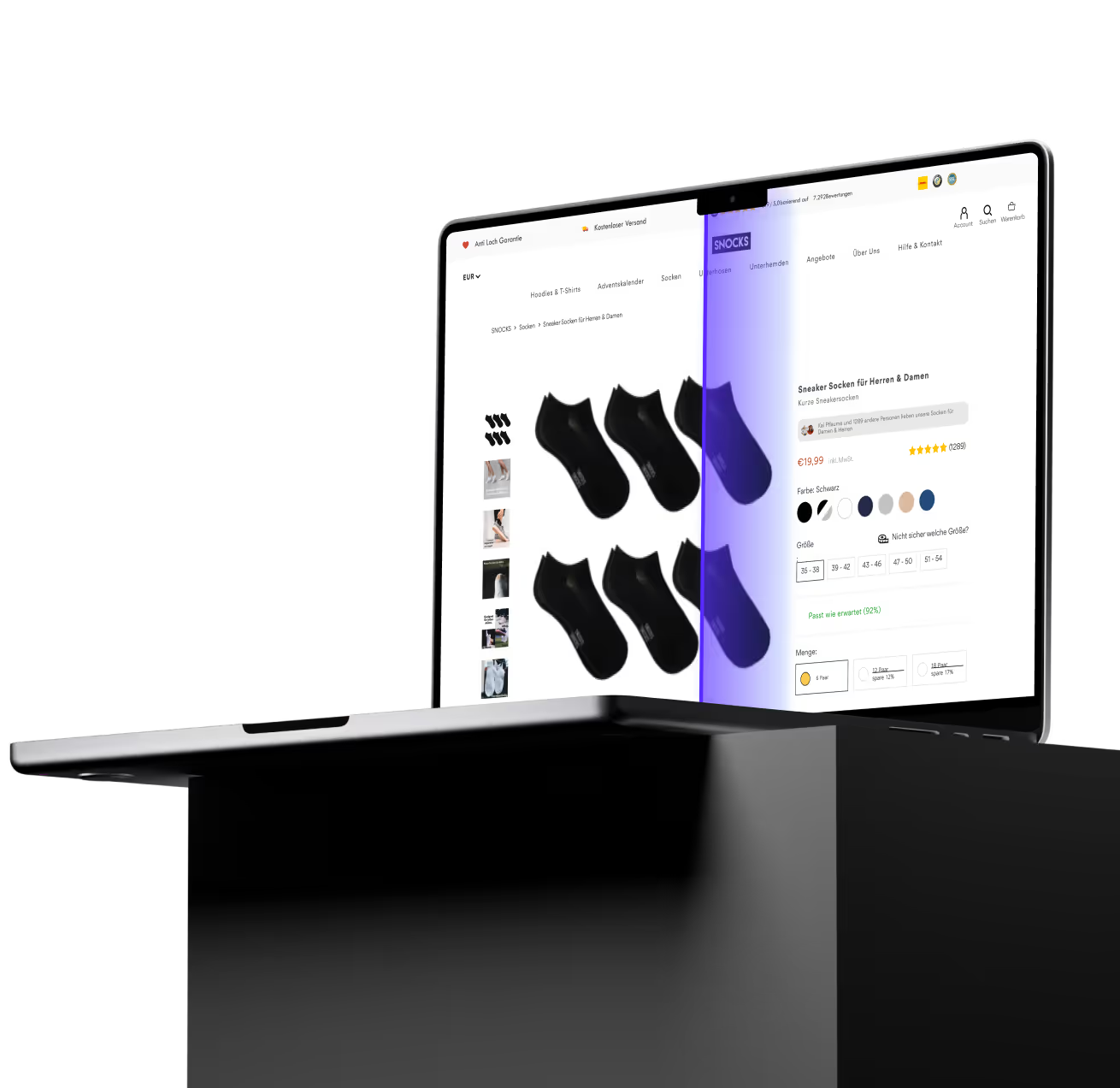
Brands that stop CRO after 6 months because 'we already improved' are leaving the majority of the value on the table. The first 6 months build the base. Months 7-24 are where compounding turns good results into transformational ones. SNOCKS kept testing for five years and grew revenue per user from EUR 2.01 to EUR 4.99.

This compounding effect is also why the cost of not doing CRO is so high. Every month without a testing program is a month where your competitors are compounding their gains and you are not. After 12 months of inaction, the gap between your performance and a competitor running a structured testing program can be 20-30% in RPU. That gap becomes extremely expensive to close.

  • Winning tests generate revenue indefinitely, not just during the test period.
  • Each new test starts from the improved baseline of previous winners.
  • 2% monthly RPU improvement compounds to 27% after 12 months and 61% after 24 months.
  • The cost of not testing is the cumulative compounded gains you forgo.
  • Most brands underestimate CRO ROI because they model linear gains rather than compounding ones.

Curious what CRO could return for your brand? See if your shop is a fit→

05How Do You Build a Business Case for CRO Investment?

Model three scenarios (conservative, base, optimistic), compare CRO cost to paid media CAC, and frame the investment as a revenue multiplier on existing traffic rather than an expense line item.

If you are a Head of E-Commerce or VP Marketing reading this article, there is a decent chance you already believe in CRO. Your challenge is convincing your CFO or CEO to allocate budget. Here is the framework we have seen work across dozens of budget approvals.

Step 1: Frame CRO as traffic monetization, not a cost center

Your company already spends significant budget acquiring traffic. CRO makes that traffic worth more. Position the investment by asking: 'We spend EUR X on traffic. CRO makes each visitor worth 10-20% more. That is equivalent to getting 10-20% more traffic for free.' CFOs understand leverage ratios.

Step 2: Model three scenarios

CRO business case: three-scenario model (EUR 50M revenue brand)
ScenarioRPU UpliftAnnual Incremental RevenueROI (on EUR 75K)
Conservative5%EUR 2,500,00032.3x
Base case10%EUR 5,000,00065.7x
Optimistic15%EUR 7,500,00099x

The conservative scenario assumes 5% RPU uplift. Present all three scenarios and let finance choose which assumption they are comfortable with. Even the conservative case shows a 32x return.

Step 3: Compare CRO cost to paid media CAC

If your blended Customer Acquisition Cost is EUR 25 and CRO produces an additional EUR 5M in revenue, calculate how much paid media spend would be required to generate that same EUR 5M. At EUR 25 CAC and EUR 60 AOV, you would need approximately 83,333 additional customers, costing EUR 2.08M in media spend. CRO delivered the same result for EUR 75K. That is a 27x efficiency advantage over paid acquisition.

Pro Tip
The strongest business case compares CRO not to doing nothing, but to the alternative use of the budget. EUR 75K in additional paid media at your current CAC generates far less incremental revenue than EUR 75K in CRO. This comparison is what makes CFOs say yes.

Step 4: Address the risk question

Every CFO will ask 'what if it does not work?' The answer: CRO is one of the lowest-risk marketing investments because you only implement changes that are statistically proven to perform better. Losing tests are never deployed. The worst-case scenario is that you learn what does not work and maintain your current performance. There is no scenario where a properly run CRO program reduces revenue.

“CRO is the only marketing channel where failure costs you nothing and success pays you indefinitely.”

Fabian Gmeindl, Co-Founder, DRIP Agency
  1. Calculate your current RPU (total revenue divided by unique visitors).
  2. Model incremental revenue at 5%, 10%, and 15% RPU uplift.
  3. Compare the CRO investment to the paid media cost of generating equivalent revenue.
  4. Quantify the compounding value over 12-24 months, not just the first quarter.
  5. Present CRO as a revenue multiplier on existing traffic, not an additional expense.
Article brief
7min read
5sections
Strategy
What this covers
  1. 01How Do You Calculate the ROI of CRO?
  2. 02What Does a Realistic CRO Investment Look Like?
  3. 03What ROI Have Real Brands Achieved from CRO?
  4. 04Why Does CRO ROI Compound Over Time?
Next step

Explore the CRO License

See how DRIP runs parallel experimentation programs for sustainable revenue growth.

Book a free call
Proof point

Read the KoRo case study

€2.5M additional revenue in 6 months after implementing structured CRO.

Read the KoRo case study

Recommended Next Step

Explore the CRO License

See how DRIP runs parallel experimentation programs for sustainable revenue growth.

Read the KoRo case study

€2.5M additional revenue in 6 months after implementing structured CRO.

11 · Common questions

Frequently Asked Questions.

8 questions · 1 honest answer each

CRO ROI = (Incremental Annual Revenue - CRO Investment) / CRO Investment. Incremental revenue equals your current annual revenue multiplied by the RPU uplift percentage. For example, a EUR 50M brand achieving 10% RPU uplift generates EUR 5M incremental revenue. On a EUR 75K CRO investment, that is a 65.7x ROI.

A full-service CRO agency typically costs EUR 8K-15K per month (EUR 70K-150K annually). Building an in-house CRO team costs EUR 150K-300K+ per year including salaries, tools, and overhead. Tools-only approaches (self-serve testing) cost EUR 500-3K per month but require existing team expertise.

It depends on store size and traffic volume. Published DRIP client results include a 25.3x program ROI at Giesswein, 15x in-test ROI at Blackroll, and 13.5x at SendAFriend. Larger stores see higher absolute returns because the same RPU uplift multiplies across more visitors. For example, a conservative 5% RPU uplift on a EUR 10M store yields EUR 500K, about 5.7x on a EUR 75K investment.

First test results typically arrive within 6-8 weeks of engagement start. Measurable revenue impact accumulates within 3-4 months. Full ROI realization (including compounding effects) takes 6-12 months. KoRo added EUR 2.56M in revenue within the first 6 months.

Yes. Each winning test raises the baseline for future tests. A 2% monthly RPU improvement compounds to 27% after 12 months and 61% after 24 months. Additionally, winning test variants remain live indefinitely, generating incremental revenue without additional investment.

Model three scenarios (conservative 5%, base 10%, optimistic 15% RPU uplift). Calculate incremental revenue for each. Compare the CRO investment to the paid media cost of generating equivalent revenue. Frame CRO as a revenue multiplier on existing traffic. Even the conservative scenario should show a clearly positive ROI for most mid-market brands.

CRO delivers the highest returns as an ongoing program because of compounding. One-time audits identify quick wins but miss the value that comes from continuous testing. Most DRIP clients maintain their engagement beyond the initial 7-month period because the compounding ROI increases over time.

CRO requires sufficient traffic for statistical significance: roughly 50,000 monthly sessions minimum. In revenue terms, stores above EUR 5M annual online revenue typically generate positive ROI from a structured CRO program. Below that threshold, the investment may still work but the absolute returns are smaller.

Related Articles

Strategy

CRO Agency vs In-House: Which Is Right for Your Brand?

Honest cost and capability comparison of CRO agency vs in-house. Real numbers on team costs, timelines, and when each model wins.

14 Feb 2026 - Fabian Gmeindl

Strategy

The Real Cost of Not Doing CRO (Revenue Leak Math)

Quantify what every month without testing actually costs your ecommerce brand. Revenue leak math with real case studies.

11 Feb 2026 - Fabian Gmeindl

Benchmarks

What Is a Good E-Commerce Conversion Rate in 2026?

Industry benchmarks for e-commerce conversion rates in 2026, plus why Revenue Per User is the metric that actually matters.

5 Feb 2026 - Fabian Gmeindl

DRIP and Apex

Spend the same on ads.
Make more from them.

Book a call with the team and tell us about your shop. We'll talk through where it stands, where you want it to go, and how we'd get you there. If working with us isn't the best return on your money, we'd tell you rather than take it.

Book a free call

30 minutes, and you'll know exactly where your shop stands.

The Newsletter Read by Employees from Brands like

LEGONikeTeslalululemonPelotonSamsungBoseIKEA

Join 17,000+ Ecom founders turning CRO insights into revenue

Trusted by 250+ brands

  • Strauss
  • Koro
  • Sunday Natural
  • The Body Shop
  • Grover
  • Hello Fresh
  • Natural Elements
  • AG1
  • Bluebrixx
  • Woom
  • Hornbach
  • Tourlane
  • Congstar
  • Holy
  • Junglück
  • PV
  • Wunschgutschein
  • Motel A Mino
  • Ryzon
  • Kickz
  • The Female Company
  • Livefresh
  • Schiesser
  • Horizn Studios
  • Seeberger
  • Luca Faloni
  • Zahnheld
  • Snocks
  • Bruna
  • NatureHeart
  • Priwatt
  • Jumbo
  • NKM
  • Oceansapart
  • Omhu
  • Blackroll
  • 1 Kom Ma 5
  • Purelei
  • Giesswein
  • T1tan
  • Buah
  • Ironmaxx
  • Waterdrop
  • Send a Friend
  • Fitjeans
  • Mofakult
  • Plantura
  • BGA
  • Coop
DRIP / Apex

Prediction-based experimentation for online shops from €100k a month.

See if your shop is a fit

Company

  • About us
  • Case studies
  • Process
  • Careers
  • Experts
  • Media
  • Reviews

Services

  • Done for you
  • Done with you
  • CRO agency
  • A/B testing agency
  • Shopify CRO

Apex

  • Apex
  • How we built the genome
  • Log in
  • Docs

Resources

  • Blog
  • Resources
  • Research
  • Benchmarks
  • Statistics tools
  • Best A/B testing tools
© 2026 Drip Trading GmbH
ImprintPrivacyTerms

Cookies

We use optional analytics and marketing cookies to improve performance and measure campaigns. Privacy Policy