01What Is Experiment Velocity and Why Does It Matter?
Experiment velocity is a deceptively simple concept: how many experiments does your team ship per unit time? But the simplicity is misleading. A team that ships 20 poorly scoped tests per month and implements none of the results has high throughput and zero impact. A team that ships 5 well-designed tests, reaches decisive conclusions on 4 of them, and deploys 2 validated winners is generating compounding value.
The distinction matters because experimentation programs are evaluated — by executives, by boards, by CFOs — on the rate at which they produce measurable business outcomes. Velocity is the leading indicator. Revenue is the lagging one. If you cannot measure velocity accurately, you cannot diagnose why a program is stalling, nor can you forecast when it will deliver returns.
Velocity is not a single number. It is a system of interconnected metrics that, together, describe the health and throughput of an experimentation program. The rest of this article breaks down each metric, explains why it matters, and gives practical ranges to aim for.
02Why Raw Experiment Count Is a Vanity Metric
When experimentation programs set a target like 'run 10 tests per month,' teams respond rationally to the incentive. They ship the easiest tests — minor copy changes, button colour variations, low-risk layout tweaks. These tests are fast to build, fast to launch, and almost never produce meaningful uplift. The dashboard shows high velocity. The P&L shows nothing.
The problem is structural, not motivational. If you measure people on the number of experiments shipped, you will get a large number of experiments shipped. You will not necessarily get learning, or revenue, or strategic insight. Goodhart's Law applies directly: when a measure becomes a target, it ceases to be a good measure.
| Metric | Program A (quantity focus) | Program B (quality focus) |
|---|---|---|
| Experiments per month | 12 | 5 |
| Decisive rate | 40% | 80% |
| Win rate (of decisive) | 25% | 50% |
| Validated wins per month | 1.2 | 2.0 |
| Avg. uplift per win | +0.8% | +3.1% |
| Cumulative monthly uplift | +0.96% | +6.2% |
| Implementation rate | 50% | 90% |
| Realised monthly uplift | +0.48% | +5.58% |
Program B ships less than half the experiments but delivers over 10x the realised uplift. The difference comes from three compounding factors: better hypothesis quality (higher win rate), more rigorous execution (higher decisive rate), and disciplined follow-through (higher implementation rate). None of these are captured by raw experiment count.
03The Five Velocity Metrics That Define a High-Performing Program
After running thousands of experiments across 250+ e-commerce brands, we have converged on five metrics that, together, give a complete picture of experimentation velocity. No single metric is sufficient. Each addresses a different dimension of program health.
1. Experiments Shipped per Month
This is the raw throughput metric — how many experiments reach a statistically valid conclusion in a given month. It is a necessary but not sufficient measure. A mature program on a single brand typically sustains 4-8 experiments per month, depending on traffic volume and team capacity. Below 3 per month, the program lacks the iteration speed to compound gains. Above 10, quality control usually degrades.
2. Decisive Rate
Decisive rate measures the percentage of launched experiments that reach a statistically valid conclusion: either a confirmed winner or a confirmed loser. An inconclusive result means the experiment consumed traffic and time but produced no actionable decision. A decisive rate below 50% signals systematic issues: tests are under-powered, hypotheses are too weak, or minimum detectable effects are set unrealistically low.
3. Win Rate
Win rate is the percentage of all experiments that produce a statistically significant positive result. Count it honestly, with inconclusive tests in the denominator. In 2024, 27% of our A/B tests won. Last quarter, 55%. A high win rate is only worth something if the tests are ambitious: a team that gets there by testing only safe, incremental changes has optimised the metric, not the shop. A win rate below 20% suggests poor hypothesis quality or a misalignment between research and testing.
4. Cumulative Validated Uplift (CVU)
CVU is the sum of all validated positive uplifts from winning experiments over a given period, weighted by the metric they target (typically revenue per user or conversion rate). This is the metric that most directly translates to business impact. A program can have modest throughput and a moderate win rate, but if the wins are large and well-targeted, CVU will be high.
5. Median Time-to-Decision
Time-to-decision is the number of days from experiment launch to a valid statistical conclusion. Shorter is better, but only if statistical rigour is maintained. For most e-commerce tests, a valid decision takes several weeks. Tests concluded after only a few days often suffer from early stopping bias. Tests running longer than 60 days usually indicate insufficient traffic for the chosen minimum detectable effect.
04The Velocity-Quality Tradeoff: How to Navigate It
Every experimentation team faces a tension between speed and rigour. Ship more tests and you risk cutting corners on hypothesis quality, statistical design, or implementation fidelity. Ship fewer tests and you risk stalling the program's compounding effect. The resolution is not to choose one over the other. It is to identify which parts of the process can be accelerated without degrading the output.
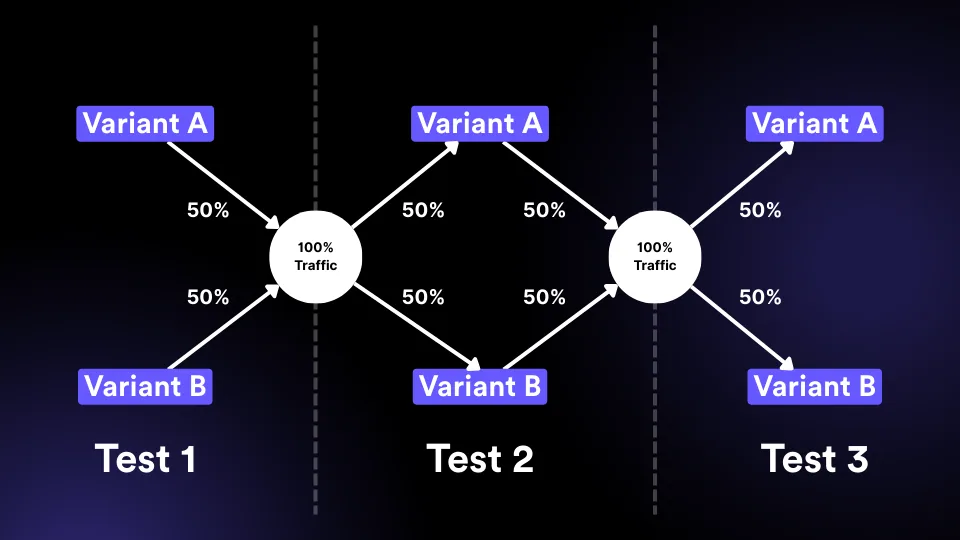
- Parallelise non-competing tests. Most brands can safely run 2-4 non-overlapping experiments simultaneously. The constraint is usually not traffic — it is the team's ability to design and QA tests in parallel.
- Reduce cycle time on QA and deployment. The biggest velocity bottleneck in most programs is not test design or analysis — it is the time between 'test is ready' and 'test is live.' Invest in deployment tooling and QA checklists.
- Use variance reduction to shorten test duration. Techniques like CUPED can reduce required sample size by 30-50%, directly shortening time-to-decision without sacrificing statistical power.
- Kill losing tests early with sequential testing. Sequential or group-sequential designs allow you to stop clear losers before reaching full sample size, freeing traffic for the next experiment.
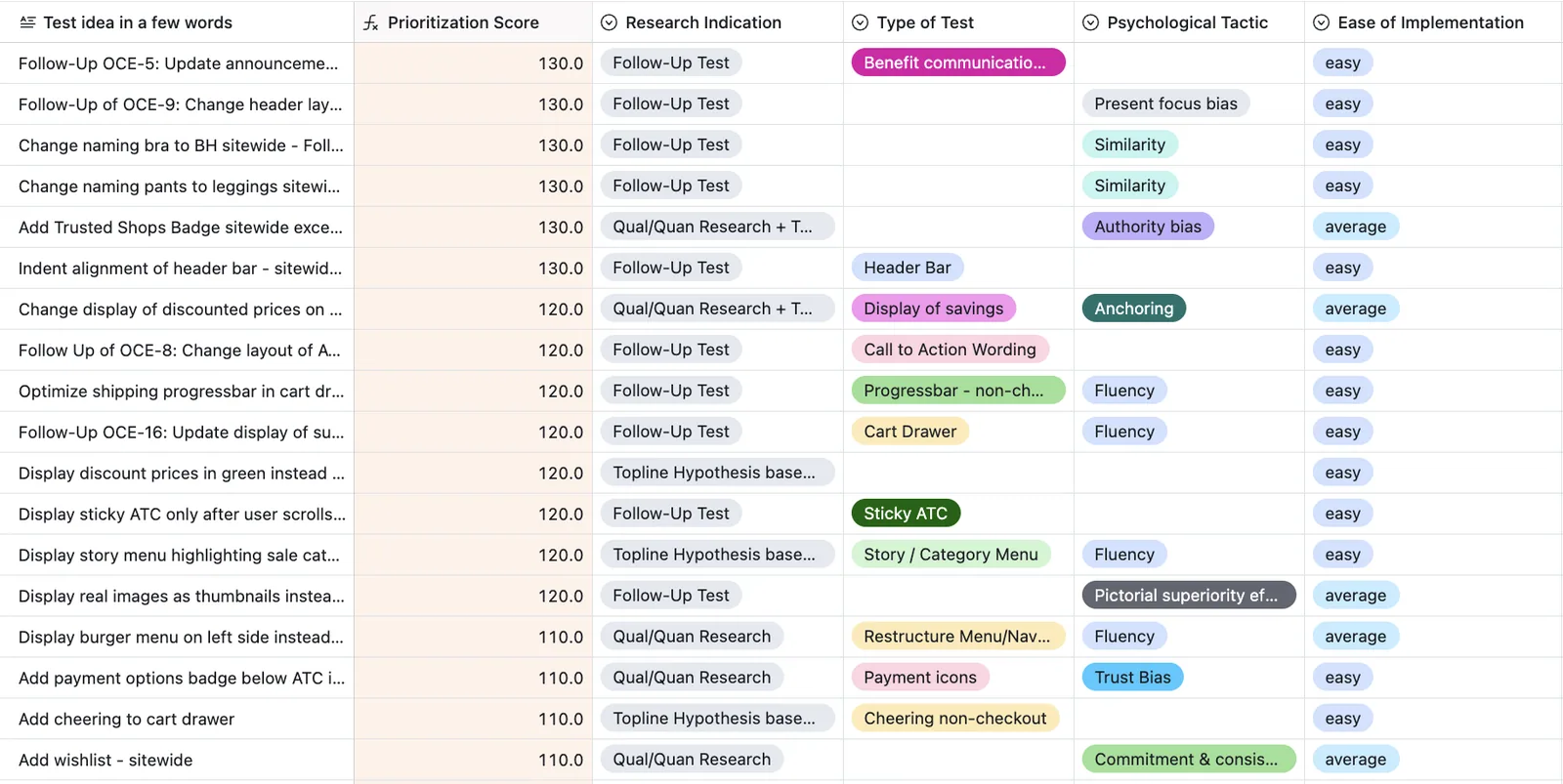
- Maintain hypothesis quality through structured research. The single largest determinant of win rate is hypothesis quality. Do not sacrifice research depth to ship more tests — it is a false economy.
| Lever | Impact on throughput | Risk to quality | Net recommendation |
|---|---|---|---|
| Parallel testing | High (+50-100%) | Low (if non-competing) | Strong yes |
| Faster QA/deployment | Medium (+20-40%) | Low | Strong yes |
| CUPED variance reduction | Medium (+30-50%) | None | Always use if available |
| Sequential stopping | Medium (+15-30%) | Low (if properly calibrated) | Yes for clear losers |
| Shorter research phase | Low (+10-15%) | High (win rate drops) | Avoid |
| Lower power threshold | Medium (+20-30%) | High (more Type II errors) | Avoid |
05How to Benchmark Your Experimentation Program
Benchmarking experimentation velocity is difficult because context matters enormously. A brand with 5 million monthly sessions and a dedicated CRO team should not be compared against a brand with 200,000 sessions and a single optimiser. Traffic volume, team size, technology stack, and organisational buy-in all constrain achievable velocity.
That said, programs tend to move through three maturity stages, and each stage has a different priority.
| Stage | Experiments per month (rough guide) | Primary focus |
|---|---|---|
| Early stage (0-6 months) | 2-4 | Decisive rate: well-powered tests that reach a conclusion |
| Growth (6-18 months) | 4-6 | Win rate: research-backed hypotheses, honest denominator |
| Mature (18+ months) | 6-8+ | Cumulative validated uplift and implementation rate |
Note the progression in implementation rate. Early-stage programs often struggle to get winning experiments deployed because the development team treats implementation as a low priority. Mature programs have established processes — dedicated sprint capacity, automated deployment pipelines, or experiment tools with built-in persistence — that ensure winners reach production within days of validation.
If you are unsure where your program sits, start by measuring decisive rate and implementation rate. These two metrics together reveal more about program health than any throughput number. A program where most tests reach a decision and nearly every winner ships is well-positioned regardless of raw experiment count.
06Building a Velocity Dashboard: What DRIP Reports to Clients
Transparency in experimentation reporting is non-negotiable. Clients and internal stakeholders need to understand not just what was tested, but how efficiently the program is operating. A well-designed velocity dashboard answers three questions: Are we testing enough? Are we learning from those tests? Are we capturing the value?
The three layers of a velocity dashboard
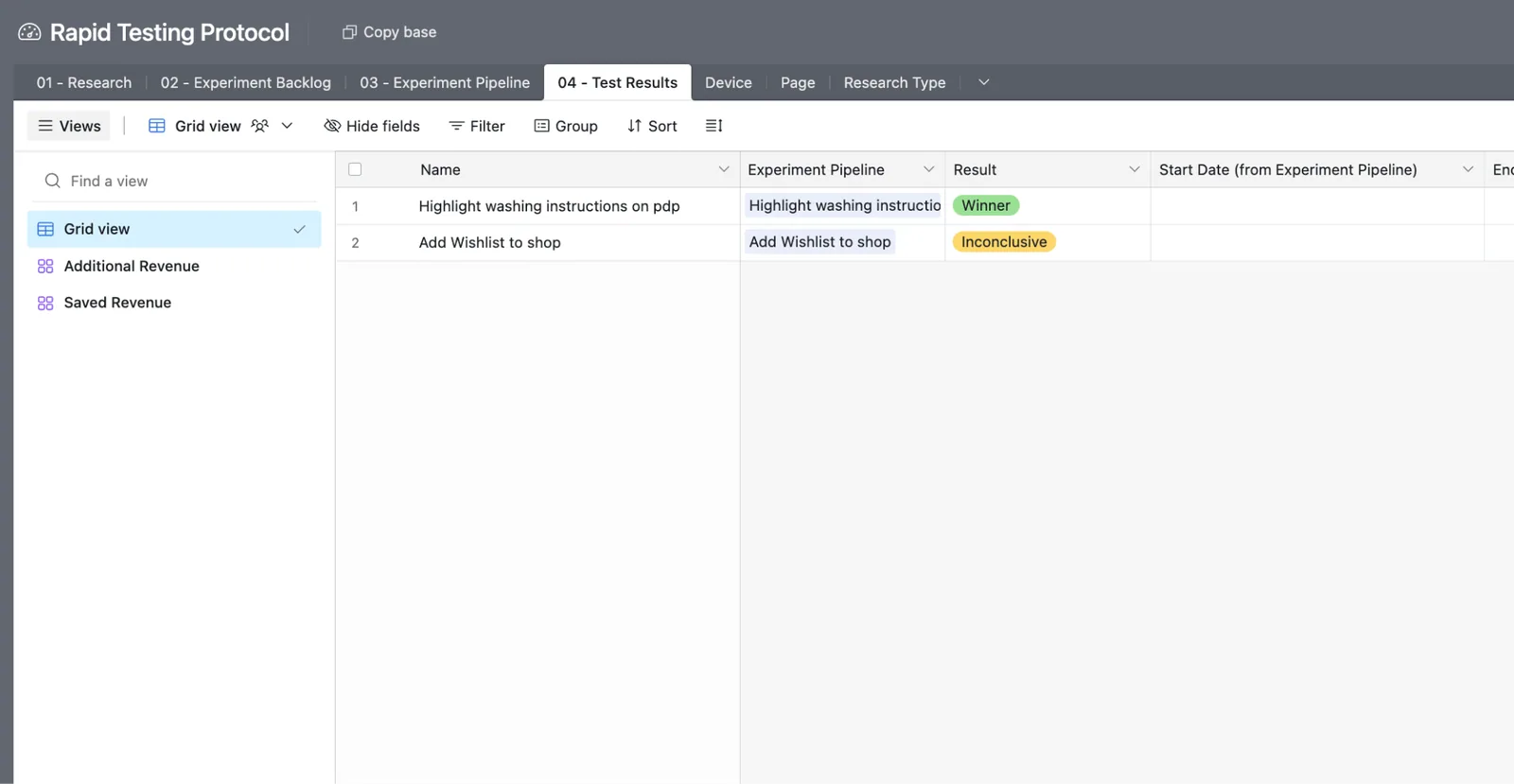
- Throughput layer: Experiments launched, experiments concluded, active experiments. This is the operational pulse — are tests moving through the pipeline?
- Quality layer: Decisive rate, win rate, average effect size of winners. This is the signal-to-noise ratio — are we learning from the tests we run?
- Impact layer: Cumulative validated uplift, projected annual revenue impact, implementation rate, time from validation to deployment. This is the business outcome — are validated wins reaching production?
At DRIP, every client receives a monthly velocity report that tracks all five core metrics alongside a composite velocity score. The composite score is a weighted index: 25% throughput (experiments shipped), 25% quality (decisive rate x win rate), 25% impact (CVU), and 25% efficiency (inverse of time-to-decision, normalised). The score provides a single directional indicator — is the program improving, stable, or degrading?
| Dashboard section | Key metrics | Refresh cadence |
|---|---|---|
| Pipeline status | Active experiments, queued hypotheses, blocked tests | Real-time |
| Monthly throughput | Experiments shipped, avg. duration, parallelism | Monthly |
| Quality indicators | Decisive rate, win rate, avg. effect size | Monthly |
| Cumulative impact | CVU (monthly / trailing 12m), projected annual revenue | Monthly |
| Implementation tracker | Wins awaiting deployment, avg. time-to-implementation | Weekly |
| Velocity composite | Weighted index (throughput + quality + impact + efficiency) | Monthly |
The dashboard should not exist in isolation. Pair it with a monthly narrative review: what worked, what did not, what surprised us, and what we are adjusting. The numbers tell you what happened. The narrative tells you why, and what to do about it.