01How Do Apex and Optimizely Compare at a Glance?
Most tool comparisons treat A/B testing software as a feature checklist: editor, targeting, segments, reports, SDKs. That framing hides the expensive problem. In a normal e-commerce testing program, about 1 in 5 tests produces a real winner. Every other test still costs design time, developer time, QA, and two to four weeks of traffic. The platform decides what you are able to test. Your idea selection decides how much of that work was worth doing.
Optimizely is the strongest answer on the market to the first question. If you need to experiment on pricing logic, recommendation algorithms, API responses, and mobile releases from one system, nothing lighter will do the job. Apex attacks the second question: it scores a test idea against a test memory of 4.3 million A/B tests before anyone builds it. The table below is the honest short version, including the rows where Apex has nothing public to show.
| Dimension | Apex by DRIP | Optimizely |
|---|---|---|
| Category | Predictive A/B testing platform for online shops | Enterprise experimentation and feature management platform |
| Core argument | Predicts which tests win before they go live | One system for every experiment and every release |
| Test memory | 4.3 million A/B tests from 151,000 shops, eight years | Not part of the product |
| Pre-launch idea scoring | Yes, every idea is scored before launch | No |
| Test creation | Build, launch, and evaluate tests directly in the shop | Drag-and-drop visual editor, plus SDKs and custom code |
| Server-side testing | Partial, decide API and a deployable edge worker, no SDKs | Yes, SDKs for Python, Java, Ruby, Go, Node.js, PHP, and C# |
| Feature flags | Yes: feature flags with rollouts and schedules | Yes, full feature management with rollouts and kill switches |
| Managed execution | Yes, tests built, QA’d, launched, and analyzed with the DRIP team | No, self-service with enterprise support |
| Statistics | Frequentist, fixed horizon by default with Holm-Bonferroni correction and an SRM gate, optional always-valid sequential analysis (mSPRT) | Stats Engine, always-valid intervals, multiple-comparison correction |
| Pricing | Book a call | From roughly $36,000 per year, up to $113,000 or more, annual contracts |
| Public review profile | Not publicly documented | G2 4.2/5 (908 reviews), OMR 3.9/5 (6 reviews) |
| Best for | Shops where the wrong tests, not too few tests, are the problem | Engineering-led organizations experimenting beyond the website |
Two rows deserve a note. Where the Apex column says “not publicly documented,” we have chosen not to fill the gap with marketing language. And the pricing row is not evasion: Apex is sold with managed execution, so the scope is set in a call rather than on a pricing page. Optimizely does not publish prices either. The figures above come from public review data, industry reports, and contracts we have seen, and they are directionally reliable rather than a quote.
02What Does Apex Do That Optimizely Does Not?
Apex has one argument, and we would rather state it plainly than bury it in a feature list. Apex predicts which tests win before they go live, from a test memory of 4.3 million A/B tests from 151,000 shops, collected over eight years. That memory is one of the largest A/B test databases in e-commerce, and it is the only reason Apex exists as a separate product.
The cleanest way to see the difference is to put the two products on a timeline. Optimizely’s strengths sit at launch and after: safe rollout, correct allocation, always-valid analysis, instant rollback. That is world-class engineering and it is genuinely hard to build. Apex sits before launch, at the moment somebody decides that this idea gets four weeks of traffic and that one does not. Nothing in Optimizely’s stack, and nothing in any statistical engine, improves that decision, because the information required is not in your own data.
The three layers, and what each one is for
- Test memory: 4.3 million A/B tests from 151,000 shops, collected over eight years. It scores every test idea before launch, so the backlog is ranked by evidence instead of enthusiasm.
- Testing tool: build, launch, and evaluate A/B tests directly in the shop. The prediction and the execution live in the same place, so the prediction is checked against the result every time.
- Managed execution: tests are built, QA’d, launched, and analyzed with the DRIP team. This is the part no self-service platform sells, and it is why Apex pricing is set in a call.
Optimizely does not compete on this axis and should not be criticized for it. Feature management and a test memory answer different questions, and a company that needs kill switches for a mobile release is not going to get them from us. If your team already knows which tests are worth running, the Apex argument is worth much less to you.
03Where Is Optimizely the Better Choice?
We should be direct here, because a hedged answer would waste your time. There is a class of company for which Optimizely is the right choice and Apex is not a substitute, and we recommend it without qualification for that class.
Feature management is real infrastructure
Feature flags decouple deployment from release. You ship code to production, expose it to 1% of users, watch the errors, and take it to 100% or kill it instantly without shipping again. Gradual rollouts, canary releases to internal or beta users, targeted releases by plan or geography, and kill switches for incident response are how large engineering organizations manage the risk of continuous deployment. Optimizely’s feature management platform is one of the most mature in the market, and it is the single biggest reason enterprises pick it over lighter tools.
Server-side testing reaches what the DOM cannot
Optimizely provides SDKs for Python, Java, Ruby, Go, Node.js, PHP, and C#, which covers essentially every backend stack. That matters because the highest-value experiments in a mature shop often are not visual at all: pricing and discount logic, recommendation and ranking algorithms, search relevance, shipping thresholds, checkout API behavior. None of those can be tested by editing the page. If your roadmap is full of that work, a client-side tool of any kind is the wrong category.
The Stats Engine, and the enterprise stack around it
The Stats Engine uses sequential testing with always-valid confidence intervals, so a team can watch results in real time without inflating false positives, and it corrects automatically for multiple comparisons. Around it sits the rest of the enterprise stack: an advanced audience builder, native connectors for Segment and other CDPs, CI/CD integration, and native pipes into Snowflake and BigQuery. For a data team that wants experiment data in the warehouse without custom work, that saves months.
04What Actually Predicts Whether a Test Wins?
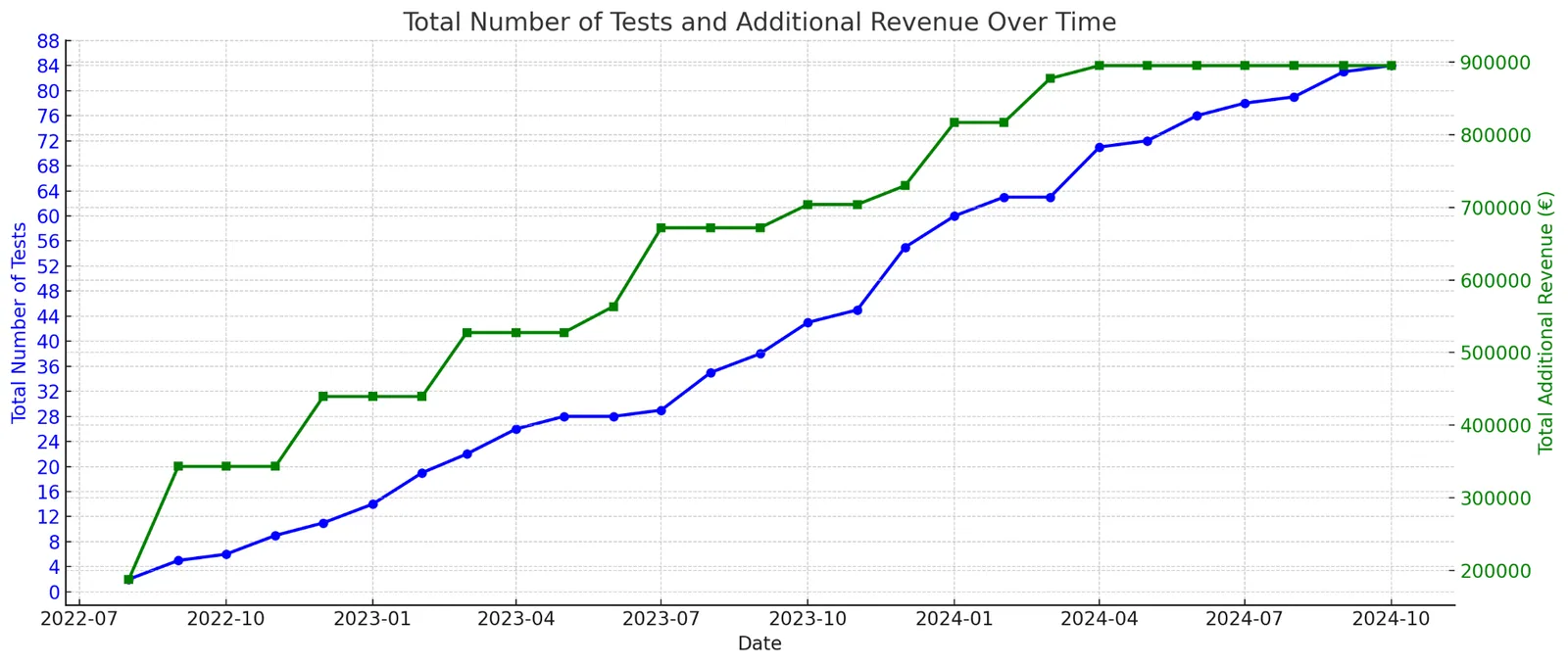
This is the part of a tool comparison that only volume can produce, so here is what our own data says. DRIP has run more than 4,000 experiments for more than 250 e-commerce brands. In 2024 our win rate was 27%, not far above the industry pattern where about 1 in 5 tests produces a real winner. In the most recent quarter it was 55%. We did not double the number of tests, and we did not change testing tools to get there.
What changed was the rejection rate. The lift came almost entirely from ideas we killed before they consumed design, development, QA, and traffic. The reliable signal was never the element itself. Trust badges, urgency timers, and image galleries all have both winners and losers in the record. The signal was context: had this change class already won on shops with a similar traffic mix, price point, and page type?
- Change class beats element: “Reduce decision cost on the product page” has a track record. “Make the button green” does not, and never will, because the same element wins on one shop and loses on the next.
- Context decides the sign: the same change frequently flips direction between a high-consideration, high-price catalog and an impulse catalog. Prior outcomes on comparable shops carry that information. A hypothesis document does not.
- Better statistics cannot rescue a weak idea: an always-valid interval tells you sooner and more honestly that a test is not working. That is genuinely valuable, and it does not change how many of your ideas were worth testing. It shortens the loss, it does not prevent it.
Note what this argument does not claim. A prediction is a prior, not a guarantee, and our win rate is our own program’s record rather than a promise for any single shop. It also takes nothing away from the Stats Engine, which does its job better than most. It says the analysis engine was never the constraint on results.
05Are You Paying Enterprise Prices for a Fraction of the Platform?
Neither vendor publishes a price, so treat these figures as directional. Based on public review data, industry reports, and contracts we have seen, Optimizely’s Web Experimentation product starts around $36,000 per year. Mid-market implementations with several million monthly impressions and more than one module typically land between $50,000 and $80,000. High-traffic implementations with Web Experimentation, Feature Experimentation, and Personalization together reach $113,000 or more. Contracts are annual, with no monthly option, so the first real evaluation window is twelve months long.
For the profile described in the previous section, those numbers are defensible. The pattern worth naming is the other one, and it is common: a team buys the enterprise platform for the name, the compliance, or one feature-flag project, then uses the visual editor, one conversion goal, and the results report. Roughly a fifth of the platform, at the full price. Optimizely is not doing anything wrong in that situation. The purchase was sized against an ambition rather than against a program.
Apex pricing is not published either, and the reason is different rather than better. Apex is sold with managed execution: tests are built, QA’d, launched, and analyzed with the DRIP team, and managed scope is not a per-seat number. It is worked out in a call against your test volume, your traffic, and how much of the work your team keeps in-house. Optimizely at least has a public floor you can plan around. We do not, and that is a real friction difference.
| Question | Apex by DRIP | Optimizely |
|---|---|---|
| What the price scales with | Scope of managed execution | Traffic, modules, and impressions |
| Contract shape | Set together with the DRIP team | Annual only, no monthly option |
| Who builds the variant | The DRIP team, or your team in the tool | Your team, in the editor or the SDK |
| Who QA’s it | The DRIP team | Your team |
| Who calls the result | The DRIP team, with the test memory as context | Your team, with the Stats Engine |
| What you need in-house | A decision maker and a roadmap | Engineering capacity and experimentation governance |
06Our Verdict: Should You Choose Apex or Optimizely?
We sell Apex, so read the recommendation with that in mind. The reasoning is simple enough to check: if about four of five tests fail industry-wide, the highest-leverage improvement available to a shop is picking better tests, and picking better tests requires outcome data at a scale no single shop can generate. That is the case for Apex, and it is the only case we make for it.
Choose Optimizely if…
- Feature flags are part of how your engineers release software, not a nice-to-have
- You need server-side experiments on pricing logic, ranking, search, or API behavior
- You experiment across web, mobile, and backend systems from one system of record
- Procurement or compliance requires an established vendor with security documentation
- Your data team needs native pipes into Snowflake, BigQuery, or a CDP without custom work
- You will genuinely use the platform you are paying for
Choose Apex if…
- Your win rate sits near the industry base rate and more tests have not fixed it
- You have limited traffic, so every inconclusive test is an expensive month
- You want each idea scored against comparable shops before anyone builds it
- You want tests built, QA’d, launched, and analyzed with an expert team
- Your experiments are client-side changes in the shop, not backend releases
One last honest note. Switching experimentation platforms is never cheap: active tests must be rebuilt, tracking reconfigured, and the team retrained. If you are on Optimizely and using the full stack, stay and use it. If you are on Optimizely, using the visual editor and one goal, and your results have been flat for a year, the platform is not what is holding you back, and neither a cheaper licence nor a more expensive one will fix it.
Want Apex to score your test ideas before you build them? See if your shop is a fit→