01How Do Apex and Kameleoon Compare at a Glance?
| Apex by DRIP | Kameleoon | |
|---|---|---|
| Built for | Shops whose tests keep coming back flat: the constraint is choosing which tests to run, not building them | Marketing, product and engineering teams that want to “build experiments in minutes by chatting with AI” |
| Shop systems | Installs as a Shopify app (two-click install via link, server-side tracking, first-party data) | JavaScript snippet on any website. Shopify app documented “exclusively” for Shopify Plus |
| Can test | Pages and page elements, parallel tests with optional exclusion groups, A/A tests, redirect tests, global holdout, feature flags and staged rollouts | Any page element the snippet can change, server-side features through flags, mobile apps (add-on), personalisation (add-on) |
| Prediction before launch | Likelihood to Win per test idea, shown with how many tests back it* | PBX Ideate suggests “up to eight test ideas for each page”, “Trained on 20,000+ experiments” |
| Building tests | Experiment config as code, code editor, visual builder (Operator), CLI preview links, MCP connection for ChatGPT or Claude | Graphic Editor, Widget Studio, JS/CSS code editor (add-on on Starter), PBX Build from chat prompts and Figma, MCP server |
| Statistics and metrics | Fixed-horizon with confidence; main metric, lift, revenue per test; profit per test on Shopify; Guardian auto-stop | Frequentist, Bayesian and sequential; multiple testing correction; CUPED and bandits as add-ons; SRM detection |
| Heat maps | Own heat maps per variant: clicks, scroll depth, average fold, funnel steps | Own heat maps: none found. Hotjar heat maps and replays tagged by variation; Clarity and Contentsquare integrations |
| AI and agents | Apex chat (what to test next, why a test won, how visitors moved, answers cite sources); backlog auto-classification and score; MCP and CLI | PBX 2.0 agents for Ideate, Build, Configure, Analyze and Ship; MCP server with 50+ tools; Claude connector; Kai assistant |
| Data location | Hosting in the EU plus UK; GDPR in place; ISO 27001 and SOC 2 in progress | Dedicated servers, subprocessors OVHcloud, Hetzner, Cloudflare; region not stated on the pages read; ISO/IEC 27001:2022 and SOC 2 Type 2 |
| Entry price | Not published; a card-free free tier for one store; book a call | PBX Starter “Starting from $495/month” (checked October 2026); 30-day free trial, no credit card |
| Reviews | No public review profile yet | G2 4.6 from 137 reviews (search excerpt); OMR Reviews 4.5 from 192 |
*Likelihood to Win is one percent figure per test idea, shown with how many tests back it. It ranks an idea against the shop’s own backlog. It is not a win probability in the strict sense.
02What Is Each Tool Built For?
Apex by DRIP is an A/B testing platform for companies selling online that predicts which tests will win before they go live. The method is called Prediction-Based Experimentation. In plain words: we know what shops like yours tested and which tests won. Apex has three layers. The test memory holds 4.3 million A/B tests from 151,000 shops, collected since 2011, and every test idea gets a Likelihood to Win before launch. The testing tool builds, launches and evaluates tests directly in the shop, with heat maps per variant, profit per test and the chat. Managed execution means tests are built, checked, launched and read together with the DRIP team.
Kameleoon describes itself with the headline “Build experiments in minutes by chatting with AI” and the line “Optimize any website by chatting with PBX, Kameleoon’s AI.” PBX stands for prompt-based experimentation. Kameleoon calls PBX 2.0, launched April 16 2026, “a suite of AI agents designed to support every stage of the experimentation process, from finding the right test idea to shipping the winning variation into production.” The company is based in Paris.
03What Can You Test With Apex and Kameleoon?
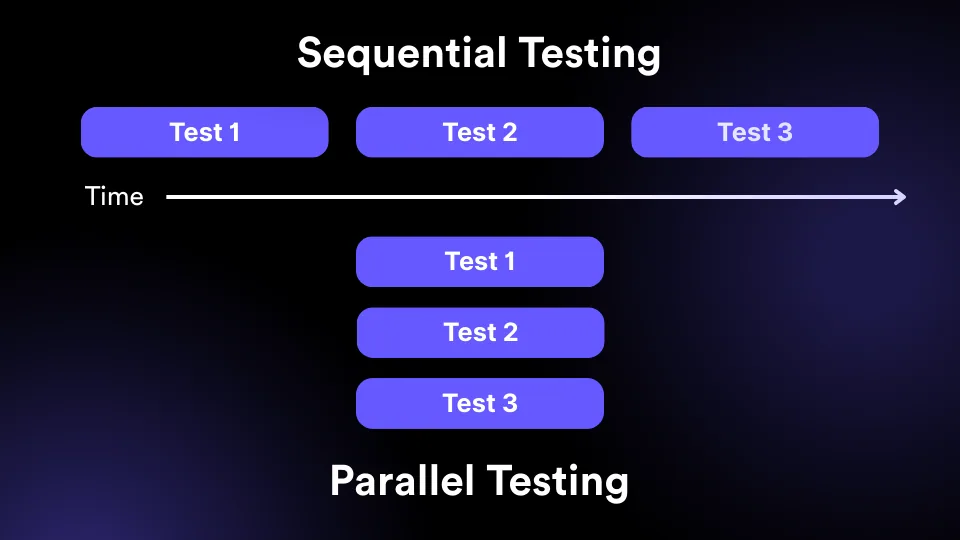
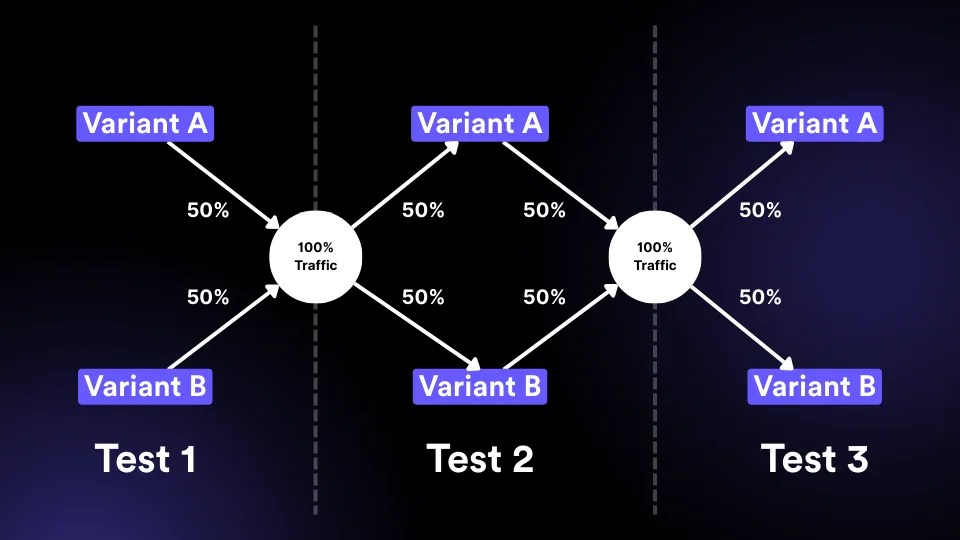
Apex tests pages and page elements in the shop, runs parallel tests on the same traffic with optional exclusion groups, and supports A/A tests, redirect tests and a global holdout. Kameleoon changes any page element its JavaScript snippet can reach and offers mutually exclusive groups and holdouts on its Starter plan.
Prices, offers and checkout: neither tool documents a native feature. Apex’s published feature list does not name price, shipping or checkout tests. For Kameleoon, a dedicated feature for prices, shipping thresholds or discounts was not found, and on Shopify it tracks checkout completion through a web pixel but changing the checkout itself was not found.
Where Kameleoon can and Apex cannot: Kameleoon offers mobile app testing and personalisation as add-ons, server-side feature experimentation through SDKs, and multi-armed and contextual bandits. Apex’s feature list names none of these. Both offer feature flags and staged delivery of features: Apex lists feature flags and staged rollouts, Kameleoon lists feature flags and feature experimentation.
04How Do Tests Get Built and Launched?
Apex
- Experiment config as code, a code editor and a visual builder (Operator).
- CLI preview links, and QA via preview. The CLI is the developer path.
- An MCP connection, so a shop owner builds and reads tests from ChatGPT or Claude without a terminal.
- Four QA checks shown to clients: all devices, tracking and targeting, responsive, matches design.
- Guardian stops a test automatically at a revenue loss threshold.
Kameleoon
- A visual “Graphic Editor” and Widget Studio. The “JS/CSS Code Editor” is an add-on on Starter.
- PBX Build creates variations from chat prompts, browses the site for context and converts Figma designs into testable code.
- PBX Configure “builds audience segments, creates goals, and launches tests through conversational prompts.” Kameleoon lists “40+ segmentation criteria”.
- An MCP server with 50+ tools; documented clients include Claude Code and Cursor. A Claude connector is open to “any Kameleoon customer with an account”. A ChatGPT connector: none found.
- PBX Ship (May 26 2026) turns winning variations into production code behind feature flags: it “pulls all the context required: variation code, the URL of the page, and the prompts that were used to build the variant.”
- Templates, redirect tests and QA tooling: none found on the pages read. Guardrails and auto-stop: none found.
Kameleoon documents a path from a winning variant to production code behind feature flags. Teams whose winners must move into their own codebase should weigh that.
05How Are Winners Chosen Before Launch?
Apex: Likelihood to Win
Every test idea in Apex gets a Likelihood to Win before launch: one percent figure per idea, shown with how many tests back it. The figure ranks an idea against the shop’s own backlog. It is not a win probability in the strict sense. The backlog classifies ideas automatically and scores them.
In a holdout check within a shop, the top third of ideas won 1.4 to 1.6 times as often (press release, September 29 2026; vendor-stated). Separately, predictions for 33 brands were scored and frozen in early September 2026; results are published from the launch on.
Kameleoon: PBX Ideate
Kameleoon’s Ideate agent “Analyzes your website to identify the highest-impact experimentation opportunities” and returns “up to eight test ideas for each page”. The Ideate page says it is “Trained on 20,000+ experiments”. The PBX 2.0 launch post gives a different figure: Ideate “draws from a database of over 25,000 experiments built over more than a decade by CRO specialists.” The two pages do not match.
Kameleoon also states, without a date on the page, “63% accuracy on high-confidence predictions, compared to an industry average of around 20%”, and says Ideate ideas are “three times more likely to convert than the industry average”. Both are vendor claims we could not check.
The difference
Apex scores each idea against 4.3 million observed A/B tests from 151,000 shops and shows how many tests back each score. The nearest published figure in this comparison is Kameleoon’s Ideate, trained on more than 20,000 experiments; Varify cites 10,000 or more test patterns; no other vendor in this comparison publishes a count of tests behind its recommendations (vendor pages checked October 2026).
06Which Statistics Do They Use and What Gets Measured?
Apex evaluates tests fixed-horizon with confidence. Each test shows its main metric, lift, runtime and revenue. On Shopify, Apex also shows profit per test, including discount share, refund share and profit per sale. Guardian stops a test automatically at a revenue loss threshold.
Kameleoon documents fixed-sample frequentist, Bayesian and sequential testing, with a multiple testing correction when “testing multiple variations simultaneously”. CUPED is an add-on on Starter and, per a search excerpt of the vendor docs, works with frequentist tests. Multi-armed and contextual bandits are an add-on. Kameleoon’s data-accuracy page states real-time SRM detection. A significance threshold, guardrail metrics and auto-stop: none found on the pages read.
If your team wants to choose between statistical methods or reduce variance with CUPED, Kameleoon documents more options.
07How Much Do Apex and Kameleoon Cost?
| Plan | Price | What it includes |
|---|---|---|
| PBX Starter free trial | Free, 30 days, no credit card | Up to 3 experiments |
| PBX Starter | “Starting from $495/month” (OMR Reviews lists €495) | Monthly billing, up to 10 experiments, 50,000 monthly tracked users, 30, 100 or 200 prompt credits a month |
| Enterprise | Custom | Unlimited experiments and tested traffic, custom contract |
Kameleoon sells add-ons on top: feature management, feature experimentation, personalisation, mobile, code editor, bandits, CUPED, unlimited teams and dedicated support. Kameleoon says “on average, our users builds an experiment by using 3 credits.” Setup fees: not published.
Apex: pricing is not published. A card-free free tier for one store exists. To see whether your shop is a fit and what it would cost, book a call. If you need a published price list before a conversation, Kameleoon gives you one and Apex does not.
08Where Is the Data Hosted and Which Certifications Apply?
Apex: GDPR is in place, hosting is in the EU plus UK, and DPAs are in place for US tools. ISO 27001 and SOC 2 are in progress, not certified. Consent apps for most Shopify GDPR apps are supported.
Kameleoon lists ISO/IEC 27001:2022, SOC 2 Type 2, PCI DSS, HIPAA, GDPR, CCPA and CyberVadis Platinum on its security portal. It runs on “dedicated servers to which only Kameleoon personnel have access”, with OVHcloud, Hetzner and Cloudflare among its subprocessors; the hosting region is not stated on the pages read. OpenAI is a listed subprocessor. Consent modes cover not required, required (tracking delayed until consent) and IAB TCF 2.3. A DPA is not published on the pages read.
If your procurement requires a finished ISO 27001 or SOC 2 certification today, Kameleoon has both and Apex does not yet.
09Where Is Kameleoon the Better Choice?
- Teams that test across web, server and app: Kameleoon offers server-side feature experimentation, mobile app testing and personalisation, and PBX Ship moves winners into production code behind flags.
- Buyers whose procurement needs certifications now: Kameleoon publishes ISO/IEC 27001:2022 and SOC 2 Type 2; Apex has both in progress.
- Teams that want to pick their statistics: frequentist, Bayesian and sequential methods, CUPED and bandits are all documented.
10Where Is Apex the Better Choice?
- Shops whose tests keep coming back flat: every idea gets a Likelihood to Win, backed by the memory of millions of observed tests, so selection improves before anything is built.
- Shops that want to see profit, not just revenue, per test: on Shopify, Apex shows profit per test with discount share, refund share and profit per sale, and Guardian stops a test at a revenue loss threshold.
- Teams that want the work done with them: in managed execution, tests are built, checked, launched and read together with the DRIP team, with heat maps per variant in the same tool.
Apex is not the right choice for every team. A team that already picks winning tests well gets less from the prediction layer. A shop that cannot ship a test a week yet should build that habit on a lighter tool first; buying prediction before you can execute is the wrong order.
11Apex or Kameleoon: Which Should You Pick?
If your tests keep coming back flat and the hard part is deciding what to test, Apex puts a Likelihood to Win on every idea before you build it. If you need to test beyond the web shop, with feature flags, mobile apps and personalisation, Kameleoon covers more ground. If your procurement needs finished certifications or a published price, Kameleoon has both today. If you run a Shopify shop that is not on Shopify Plus, note that Kameleoon’s Shopify integration guide applies “exclusively to users with both a Shopify Plus and Kameleoon account.”
Want Apex to score your test ideas before you build them? See if your shop is a fit→